FOREWARD
And yes, that teacher was me. I taught elementary music in the public schools in Amarillo, Texas for almost 21 years. I taught at Landergin Elementary for three years and then at South Lawn Elementary from 1999 until the spring of 2017. I didn’t finish out the 2016-17 school year because in the Spring of 2017, I was put on administrative leave while the district investigated accusations that were made against me by eight 5th graders. This is the true story of the events that led up to this unusual and I think, incredible story being allowed to happen.
Let’s get a few things straight right off the bat. First of all: I was a bad teacher. Let’s be clear about that. If you were to ask my former superiors and colleagues, that’s the first thing (if they’re being honest) they would tell you about me. And they’d be right. In my class, there was no learning taking place. I basically spent the majority of class time trying to get students to do what I wanted instead of what they wanted.
I wanted them to sing. They wanted to talk. I wanted them to play instruments. They wanted to talk. I wanted them to learn music. They wanted to talk. And misbehave and disrupt class. And most of the time we ended up doing what they wanted instead of what I wanted. Don’t get me wrong. My students would be the first to tell you that music class was fun.
Fun for them. Torture for me. Actually that’s not quite true. For the majority of my students, music class wasn’t fun. The reason it wasn’t fun was because the students with persistent misbehavior were allowed to hijack the class. For THEM music class was fun.
The fun part came in challenging my authority, saying and doing things in my class that they’d never get away with in a million years in any of their other classes. What wouldn’t be fun about that for a lot of 10 year olds? How you gonna keep’em singing down on the farm once they’ve tasted the blood of successfully wresting power from an authority figure? Isn’t that how that saying goes? So there’s that. I was a bad teacher.
The second thing to be clear about is this: To any of my former students—the ones always getting into trouble, and especially the students alluded to in the title—
IT WAS NOT YOUR FAULT.
2
In this accounting; I pledge to tell the truth, the whole truth, and nothing but the truth. With one exception. My number one priority in writing this is to protect the children who were my students. Because it was not their fault. And how could it be? Most 5th graders are 10 , 11 years old. They should not have been allowed to wield that much power in the first place. Therefore the names of all students have been changed. Because it wasn’t their fault.
But unlike the kids’ names, I have not changed any adults’ names (with one exception). As I’ve already said, I am determined to tell the truth (except where otherwise noted above) no matter who it shines an unflattering light on. Including myself. So you will not read a story of good guys vs. bad guys, but rather a cautionary tale: If it can happen to me, it can happen to somebody else.
My intent in writing this is not to discredit, disparage, or slander anyone. I am not after revenge but I do want to restore my name. I am going to try to do nothing more than simply report what happened to me and then let you, the reader, decide if what happened was fair and just or not. And finally, as I write this in August of 2019 (more than two years after the fact), I have to admit that I haven’t come to peace with it. I’m still struggling to make sense of it. My hope is that if I write about it, maybe then will I finally understand what happened. And why.
And to my former students: It was not your fault.
AUTHOR’S NOTE: I basically finished writing this in the summer of 2019 (excluding a few rewrites). So here’s what you won’t get in this: anything having to do with covid. That fact will automatically date this book (or document or whatever you want to call it) but I’ll save writing about covid for another time.
9/14/20
©2019 by Pat Turman
3
TABLE OF CONTENTS
Foreward . . . . . . . . . . . . . P. 1
March 3, 2017 . . . . . . . . . . . . P. 5
True North . . . . . . . . . . . . P. 7
THE TEST . . . . . . . . . . . . . P. 9
Speechless . . . . . . . . . . . . . P. 11
Letter to an Unknown Woman . . . . . . . . . . P. 13
Running with the Herd . . . . . . . . . . . P. 16
Thank You . . . . . . . . . . . . . P. 18
My First Bad Evaluation . . . . . . . . . . . P. 21
I Won’t Back Down . . . . . . . . . . . . P. 26
The Carrot and the Stick . . . . . . . . . . . P. 29
More Pressure . . . . . . . . . . . . P. 34
Old Friends . . . . . . . . . . . . . P. 39
February 28 . . . . . . . . . . . . . P. 44
5A . . . . . . . . . . . . . . P. 47
Take Down . . . . . . . . . . . . . P. 49
Letter to Doug Loomis . . . . . . . . . . . P. 51
Aftermath . . . . . . . . . . . . . P. 58
Hindsight . . . . . . . . . . . . . P. 61
Speaking Out . . . . . . . . . . . . P. 63
5
MARCH 3, 2017
“Mr. Turman, could you please come to the office?”
“I have to pick up my class.”
“Somebody will get your class. We need you to come to the office right now, please.”
This is the conversation I remember having in my room with my principal over the loudspeaker in my classroom on Friday, March 3, 2017 during my lunch period and only a minute or two before I was scheduled to go get my next class. As I walked to my principal’s office I remember being nervous. I was nervous because I knew why I was being summoned to the office. I couldn’t help think, as I walked down the hall with butterflies in my stomach, that this must be exactly how some of the kids felt whom I’d sent to the office for misbehaving in my class, which lately had been happening a lot.
When I sat down with my principal, Donna Harris, I noticed that she had several papers in front of her on her desk. I couldn’t read what they said because they were upside down. But even though I couldn’t read them, I could make out that they were all written by students. They were all written in that crude way of printing that all kids seem to share. And even though I didn’t know what those papers said (to this day I have never read them), it was obvious from Donna’s demeanor that whatever those papers said was serious, as a heart attack.
I don’t remember verbatim what was said in that meeting with Donna but I do remember the gist of it went something like this:
“Can you tell me what happened this morning during your 5th grade class?”
“What with Nate? He was being disruptive so I sent him to the office.”
“And that’s all that happened?”
“Yeah, for the most part.”
“That’s not what these say,” Donna held up the papers with the kids’ writing on them.
“What are those?” I asked her.
“These are statements written by eight 5th graders who were in your class and say you did a lot more than just send Nate to the office.”
As I said, to this day I haven’t read them. But I did know I hadn’t done anything seriously wrong. And so when Donna told me I needed to go to the ESC Building (the administrative building for the Amarillo Independent School District—A.I.S.D.) and talk to a lady and tell her what happened, just for documentation, I wasn’t overly concerned.
6
I wasn’t concerned, partly, because I was a teacher with an unblemished record for over 20 years: no formal complaints from parents, no write-ups, nothing in my file whatsoever to suggest anything but a respectful and caring attitude towards his students.
And so I happily trudged off to meet with the lady whose name Donna had written on a sticky note, completely oblivious to the noose that was inexorably beginning to tighten around my neck and not knowing that I would never teach at South Lawn again.
The lady whose name Donna had written down on the sticky note turned out to be Karen Atkinson, the head of human resources for elementary schools. And after being grilled by her like a defendant in a criminal court by the prosecuting D.A, I was put on administrative leave while the district investigated what the eight 5th graders had accused me of in their written statements: that I had assaulted a student.
7
TRUE NORTH
And just for the record, I have to tell you that I wasn’t always a bad teacher. I didn’t become a teacher until I was 32. I had spent most of my 20s bouncing around with clearly no purpose. I had been to three different colleges. I had worked several menial jobs while living with my parents. I had lived in a suitcase, travelling all over the country playing music in bar bands. I was going nowhere fast. But my life changed in 1988 when I accepted Jesus Christ as my personal Savior.
For the first time in my life, I had a purpose. I had always kind of known I was supposed to be a teacher (I had majored in music education at the three colleges mentioned earlier). But now I knew that it was God’s call for my life. That made all the difference. I buckled down and applied myself like I never had before and in 1995, I graduated from the University of Northern Colorado with an overall G.P.A. of 3.8. My wife and I (I had also gotten married around this time) told ourselves that we would accept the first teaching job I was offered which happened to be for the Amarillo Independent School District starting in the fall of 1996. So on August 2, 1996 (I’ll never forget the date), my parents helped my wife and I move from Denver, Colorado to Amarillo, Texas.
I had been hired as the music teacher at Alice Landergin Elementary School in the fall of 1996. I taught at Landergin for three years until I transferred to South Lawn Elementary to teach music beginning in the fall of 1999.
Like most new teachers, I did a lot of trial & error to see what worked and what didn’t. And like most new teachers, the majority of it didn’t. The truth is, there are no such things as “good” teachers and “bad” teachers. Those aren’t accurate words to describe what teachers do. Really, there are “effective” teachers: ones who are able, for whatever reason, to instill something in their students that makes them want to learn what the teacher is teaching and “ineffective” teachers: teachers not capable, for whatever reason, of motivating students to want to learn.
Well, my first years at South Lawn, I was an effective teacher. My students loved my class. Part of it was because my class was such a contrast to what the music teacher previous to me did. Basically, in her class, all they did was sit and sing or sit and watch videos (funnily enough, that’s basically what I would be reduced to 15 years later). But I wanted them up and moving, I wanted them playing games, I wanted them having fun. And it worked! Because that’s exactly what we did: Have fun!
8
I started an extra-curricular showchoir of students that met after school which went around town performing. I put on elaborate musicals (with the help of another teacher who designed amazing costumes and set decorations) that were standing room only when we performed them on the stage in our cafeteria. And I was voted Teacher of the Year for South Lawn by my fellow teachers in 2001. It was the happiest time of my career as I felt I was fulfilling the purpose God had given me.
I’ll tell you, knowing that you are making a difference in a child’s life is, for a teacher, the greatest feeling in the world. That’s why I became a teacher: to help kids. That’s why most teachers become teachers. That’s also why most people choose to become doctors, lawyers, policemen, or fire fighters: to help people. But unfortunately this world has a mysterious way of taking our youthful idealism and turning it into a hardened cynicism. And making us not care. I was no different. And so I became the very thing I had dreaded and promised myself I would not become: a teacher who made no difference. I had lost my “True North.”
When I was a beginning teacher, just in my first or second year, I read an article by Robert L. DeBruyn called Never Let Go of Your True North.
See ADDENDUM 1
In it, it says “True north might be thought of as our life’s work and mission. What is important to us? What difference do we want to make in our lives and the lives of those around us, including our students? Our answers give us our personal true north.”
It goes on to say “A close look will reveal that it was our true north that led us to a profession in which we help to shape the lives of young people. Our true north rests on noble intention: service to humanity and commitment to make the world a better place because we passed through it. Without question, our work with students every day and each year moves us ever closer to fulfilling our lifelong purpose.”
And how did I lose my True North?
Well, from the beginning, I saw my school doing things that I disagreed with philosophically. Things my colleagues and superiors were doing that I thought were bad for the kids. Things that I should’ve spoken out against. And didn’t. The first and foremost of these being THE TEST.
9
THE TEST
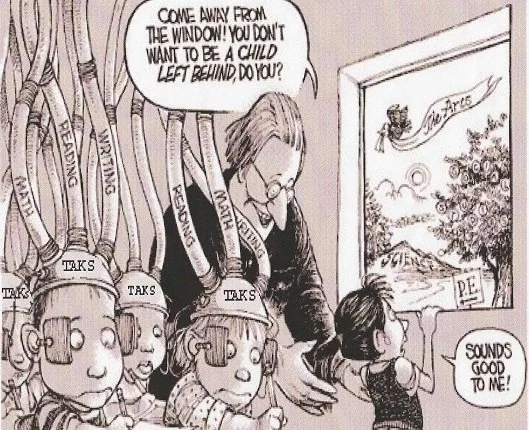
THE TEST is what I like to call the standardized tests that drive the whole existence of the Amarillo School district, the state of Texas , and to a lesser degree the country. When I first started teaching in Amarillo, THE TEST was called TAAS, then TAKS, now STAAR (which are all eduspeak acronyms that I won’t bore you with).
Let me tell you a little something about THE TEST: It is the 500 pound gorilla in the room that has squeezed everything else into an out of the way corner. The only thing that matters, the only thing focused on from the first day of school to the last is getting the kids ready to take THE TEST. And the only value anything else has, is to what extent it supports or doesn’t support THE TEST.
THE TEST is what each and every school starts teaching towards on the first day of school. And when THE TESTS have been taken (some as early as February, some as late as May depending on the grade and subject), then the very next day they start preparing for next year’s TEST. There are some teachers who tell themselves and others that THE TEST is actually good for the kids. They live or die waiting in suspense for their students’ test scores to be made known to themselves and the public as if they’ve won the lottery or cured cancer. And for these teachers I have nothing but understanding and empathy.
Because as Marlon Brando said in Apocalypse Now (he wasn’t talking about standardized tests but it does serve to summarize what they are): “They must be regarded as your friend, because if they’re not, then they are truly the enemy to be feared.” So I can understand any teacher embracing the red hot grail that is the Test because, truly, what choice do they have? So some teachers (and all administrators) embrace THE TEST. But most teachers, if they were honest (which they can’t be), would tell you they hate THE TEST and that it does more harm than good to the kids. But trying to fight THE TEST would be pure folly. At best it would be like trying to stop a tidal wave and at worse it would be career suicide.
As for me, I did what most teachers do when it comes to THE TEST. I secretly hated it but I endured it and I gave it lip service when necessary to stay out of trouble with the powers that be (my bosses and their bosses). But then I had to slowly watch my music program get pushed aside, along with everything else, I might add.
So if you want to know how I lost my True North, I think it was a direct result of THE TEST. Because I saw the harm that it was doing but chose not to speak out . But maybe I should have tried to fight it, or at least done something instead of nothing, which is what I did. I think that’s my one and only sin as a teacher, because not speaking out about something I was philosophically opposed to cost me my True North.
10
So what could I have done? I could have voiced my concerns at faculty meetings or school board meetings. It would have been like fighting City Hall (and then possibly even the state capitol--like I said, THE TEST is a disease that infects the whole state of Texas, not just the Amarillo school district). I would probably have lost my job but so what? As you probably already know or already guessed, I lost my job anyway.
I know I’m sounding overly dramatic but there are two rules in AISD. 1st rule: You do not talk about how much you hate THE TEST. 2nd rule: You do not talk about how much you hate THE TEST. Okay, not really but you get the point. Speaking out about how much you hate the test is career suicide.
Or maybe I should’ve just cut my losses and high-tailed it out of there. I probably could’ve found a job in a school district that was more in line with my own educational values. I was also certified to teach in Colorado, after all, a state notably less conservative than Texas (actually, every state is notably less conservative than Texas but that’s another story). But I didn’t do that either.
Instead, in 2007, when my new principal informed me that we were going to have to discontinue showchoir because it interfered with after-school tutoring, I did not protest or offer any resistance. And again--a year later--when the same principal told me we were not doing any more Christmas or Holiday programs because the teachers felt they were too big of a distraction from THE TEST, I went along with it without a peep.
Okay, remember when I said this was all about me being honest? Well, I have to be honest here. One of the reasons (a big reason) I didn’t speak out or resist these decisions was because part of me (a big part) was glad not to have a showchoir or to have to put on programs.
Because they are a lot of work.
A lot more than most teachers or even administrators realize. So not having to do that instantly cut my work load by 35%. But I also knew it was a bad decision for the kids. And there were other decisions made concerning the music program that were bad for the kids. And again, it was all about THE TEST: the willingness to sacrifice the students’ well-rounded education in pursuit of a yearly test score. And I knew it was wrong and didn’t say anything.
11
SPEECHLESS
The years from 2007 until 2015 were the years I lost my True North. I call them the Dead Years. Oh sure, I did my job. I dotted my i’s and crossed my t’s. I had good evaluations every year. But I saw myself making less and less of a difference in my students’ lives. Gradually and more often, I started to see students who didn’t like my class. And I have to be honest and say that this was mostly my fault.
Looking back, I think the main problem was the students could sense that I really wasn’t committed and just going through the motions. They could sense that I really didn’t want to be there. And teachers who are not enthusiastic about what they’re teaching are not going to reach their students. And so the activities in music class that they loved and thought were fun a few years earlier now seemed old and tired. And they were right.
But even though I have to take the majority of blame for this, it wasn’t all my fault. Administrative decisions also played a part in eroding the quality of my students’ experience in music class. For example, the 77th Texas legislature passed a law which said students could no longer be pulled from p.e. classes in order to do make-up work or to receive individual instruction (the law was passed in 2001 but didn’t go into effect in AISD until 2007). Well, which class do you think ALL the kids got pulled from as a result of that law? That’s right. Music class.
See ADDENDUM 2
Ask a classroom teacher how well her students are going to do on THE TEST if on any given day, 15% of her class isn’t there—and it’s never the same 15% or for the same length of time.
Also it was decided at South Lawn in 2007 that each grade would all have their planning period at the same time. This is great as far as giving the grade-level teachers time to collaborate (for the sole purpose of trying to get students to perform better on THE TEST) but it basically doubled my class size overnight. Again, ask a teacher if her scores on THE TEST are going to go up or down if overnight, her class size goes from about 20 students to 40 students.
And then finally, the real coup de grace occurred when in 2011 I had to move my class to a portable. So not only did I have twice the kids, I also now had only half the space. This was decided when I had to sacrifice my classroom to a new teacher when our school added an extra 3rd grade class because of an increase in numbers. It meant all the 3rd grade classes could be down the same hall.
12
Which was great for them, maybe, but not so great for music class. The classrooms don’t have a built in movement component (they’re basically sitting all day doing paper work) but elementary music does--we want them up moving, singing, dancing, and playing—which is impossible if you’re packed like sardines in half a portable (the other half was a pre-k class).
Sure, me giving up my room might’ve been the best choice as far as THE TEST is concerned but you decide which was the better option for the KIDS. I mean, SO WHAT if the new 3rd grade class is not in the same hall as the other 3rd grade classes?
So as you can see, a lot of changes happened during my “dead” years to erode the quality of the music program at South Lawn. During my “dead” years, the music program was simply an inadvertent casualty, something that got pushed aside to make more and more room for THE TEST.
During these years, I actually felt more like an independent contractor than anything else. There was something of an unwritten contract between my administrators and myself during this time: They would leave me alone to teach whatever I wanted in my class if I would not send kids to the office or in any other way distract them from doing what they had to do to get the students ready for THE TEST.
You see, one of the worst things a teacher can do, in the eyes of most administrators, is send a kid to the office. Sometimes it has to be done and administrators understand that. If a child intentionally hits or injures another child or willfully destroys school property or does something extremely inappropriate (use your imagination on that one), then a teacher can get in trouble for NOT sending a kid to the office.
But for the most part, administrators expect teachers to handle discipline issues on their own and only send a student to the office as a last resort after all other disciplinary tools have been exhausted. And I actually agree with that. In fact, for the first 15 years of my almost 21 years of teaching, I took pride in the fact that I sent so few kids to the office.
You know how they say you should save tax returns for three years? Well, I saved everything from South Lawn, only I saved stuff for five years instead of three. So I have all school records and documents from 2012 and every year after. Everything before that, I’ve tossed (I lost my job in 2017).
So I’ve forgotten how many kids I sent to the office every year up to 2012. For the records I do have, it shows that in 2012-13 I sent five students to the office. In the year 2013-14, I sent 19 students to the office.
Wanna know how many I sent in the year 2014-15? 86. Yes, you read it right.
EIGHTY-SIX!!!
And what happened in 2014, you might ask? That was the year we got a new vice-principal.
13
LETTER TO AN UNKNOWN WOMAN
Remember when I said I wasn’t going to change the names of any adults except one? Well, this is the one. I am going to change the name of one adult: the lady who became our vice-principal in 2014. Why am I doing this? For two reasons. First, to guard against being sued for libel. I’m almost positive that what you are about to read is not defamatory in any way but I’m not going to give AISD even a sliver of a chance of threatening a lawsuit with the intention of forcing me to remove this off of my website.
And second, because I think the “unknown woman” in question is a good, Christian lady (We never actually talked about religion so I am presuming.) who is still an administrator at an AISD school (not South Lawn). And I don’t want to cause problems for her at her present school.
But the people who were my colleagues at South Lawn from the fall of 2014 until the spring of 2017 (when I lost my job) will know who I’m talking about. So in this book, I’m going to call her “Cathy.” I thought about calling her Lisa (the name of Joan Fontaine’s character from the movie whose title I am taking for this chapter) but then readers might think I am referring to Lisa Morgan, who was my principal from 2012 to 2015. Lisa Morgan is NOT the person whom henceforth, I will call Cathy.
Cathy, when you became vice-principal at South Lawn in the fall of 2014, I guess you could say that you and I didn’t get off to a very good start. I remember, Cathy, in the first weeks of school you wanted a student who’d gotten in trouble with another teacher to spend the day with me (a version of “in-school suspension”) and I told you I wasn’t comfortable with that and so you never did it again. Remember that? I’m sure in your mind that the impression I made on you because of that was that I wasn’t a team player.
Cathy, back in 2014, you were basically in charge of discipline so the principal could attend to other matters, mainly THE TEST. So if a kid was sent to the office, you were the one expected to deal with him or her, not the principal. Right?
14
So why did I send so many kids to the office for you to deal with? Believe me that was not normal for me in my almost 20 years of teaching music prior to you becoming my vice-principal. The year before (2013-14), I had 19 office referrals, which for me was a lot but nothing compared to how many I sent you. In 2014, I guess I felt that after sending a student to the office, nothing would happen. More often than not, they wouldn’t be given any consequences. And so, it became a vicious cycle: I would send kids to the office and resent you for not doing anything about it. And the more I sent, the more you resented me for sending so many kids to the office.
And I don’t know what it was that year but something came over me that like I said, was not normal for me. Maybe subconsciously I wanted to force a change, some desperate need to somehow claw my way out of the teaching rut I’d fallen into. I don’t know. What I do know is I felt strangely emboldened. And is there a better example of the fine line between courage and stupidity than a teacher brazenly sending 86 kids to the office in one year? Because it didn’t feel stupid at the time (unfortunately for me). It felt right.
The way I saw it at the time was that you weren’t doing your job (and I’m sure that’s exactly how you felt about me). I thought that because according to the AISD and TEA discipline policies, what was supposed to happen when a student got sent to the office was: The student was to receive whatever consequence(s) the administrator deemed appropriate, a call would be made to the student’s parent or guardian explaining what had happened, and the administrator would then document actions taken and the teacher given a copy of said documentation. But that’s not what happened to the vast majority of students I sent to the office. To the vast majority, the only consequence they received was to sit in the office until music class was over and then go back to their classroom.
And you should know that with most of those students that I sent to the office (not all, but most), I had exhausted every disciplinary tool at my exposal (call home, contacting their teacher, rewards & consequences given—the ones that weren’t taken away from me that is) BEFORE sending them to the office.
And also you should know that of those 86 trips to the office, the same 13 students were responsible for 58 of them. And as anybody would know who is at all familiar with the TEA and AISD discipline policies: When it comes to persistent behavior problems, I am not only entitled to send those kids to the office, I’m OBLIGATED to do so.
See ADDENDUM 3
But you ended up getting the last word, didn’t you? And in case you’ve forgotten about it, what I’m referring to is the pie chart that you handed out to every teacher at a faculty meeting we had in the Spring of 2015.
15
In it, you broke down exactly how many times each teacher had sent a kid to the office.
See ADDENDUM 4
I had the most with 48 (You handed out the chart at the beginning of 2015—which meant I still had a few months to get up to the 86 total I eventually sent to you by the end of the year). Second place was a teacher who, with 19 referrals, had less than half the number I did. The vast majority of teachers were represented by a small sliver on the pie chart (ten referrals or less). Let me try to explain how devastating this was to me.
The most difficult day in my life as a teacher was my last day of teaching at South Lawn—March 3, 2017. The second most difficult day in my life as a teacher was the day you handed out that pie chart. Looking back on it, I’m inclined to think well, okay, yeah it was an unpleasant thing to go through but it wasn’t the end of the world. But it sure felt like it at the time. I was devastated.
For one thing, I wasn’t expecting it. I just remember sitting there, looking at the pie chart with all the other teachers and literally wanting to die. Here it was, evidence for all the world to see how bad of a teacher I was. And strangely enough, I remember there wasn’t any discussion about the pie chart at the meeting. You just handed it out and then we had our meeting. I don’t remember now what the meeting was about (I’m sure it had something to do with THE TEST) and I sat there not really listening because I felt publicly humiliated. After this incident, I definitely could understand one reason classroom teachers would be motivated to score well on THE TEST. Those scores are eventually made public and what could be more horrifying than bad test scores for all the world to see?
Anyway, I don’t know if the intention of the pie chart was to shame me, but that’s what it did. But it didn’t really stop me from sending kids to the office, did it? I didn’t back down, did I? As evidenced by the fact that by the end of the year, I had almost doubled the number on the chart (for a total of 86). The truth is I was devastated by the pie chart. And also I had managed to not only alienate, but to downright antagonize the people (my administrators) whose support I needed to do my job. But if I had to do it over again I would probably do it exactly the same. Well, that’s about all I wanted to say to share with you so take care and God Bless.
Sincerely,
Pat Turman
P.S. Yes, I would do it exactly the same again. Because the whole experience actually helped me in a very profound and important way that changed my life as a teacher. And Cathy, I have to thank you and your pie chart for that. It DID help me claw my way out of my teaching rut, which I will clarify presently. But first, a word about llamas.
16
RUNNING WITH THE HERD
Doug Curry is kind of a big shot in the Amarillo School District. He was a successful teacher and then a successful principal (meaning, of course, he got the kids at his schools to do really, really well on THE TEST). He then quit education to write a book about education and to give motivational speeches to teachers about education (Aside: I’ve always found it interesting how these educational gurus who love kids & love teaching and have so much educational wisdom to impart—the first thing they do after they’ve become a successfully renowned teacher is quit teaching and go write a book and give speeches.)
Actually he does have a lot of wisdom to impart. I’ve heard him speak several times. He wrote a book called How to Train a Llama-The Art and Science of Classroom Management. In it he compares being a teacher to being a llama in the wild. It’s actually a very insightful and useful metaphor. He writes, and I quote: “Teachers are like a herd of llamas, running through the grass. Kids can be vicious tigers, looking for a victim. Are you the slowest llama? Don’t be the slowest anymore! Come learn how to successfully manage your students…These are proven techniques that…will help you claim the power that you own to be able to make your learning environment exactly what you want it to be. Run fast, little llama!”
Well that metaphor is an exact description of the overall teacher/student dynamic in most schools. Walk into any school and there’s usually 5 to 10% of amazing teachers who have the ability to motivate students and get the students to walk through fire for them (the leaders of the herd and the fastest llamas). Then there’s most teachers (about 85%) who struggle on a day to day basis to get the students to do their work but somehow succeed and are able to earn the kids’ respect (they’re the bulk of the herd). And then there are the one or two teachers whom the students not only don’t respect but whom they actually go out of their way to misbehave for.
These teachers are the slow llamas that the kids target, single out, separate from the herd, and take down. Well, for most of my years as a teacher, I was smack dab in the middle of the herd—running for my life but basically safe from the vicious attacks of misbehaving students. But it started to get to me and so I started to gradually run slower and slower. And eventually I became the slowest llama that the kids targeted and finally came the fatal TAKE DOWN on March 3, 2017.
17
And I will henceforth refer to that day (my last day of teaching at South Lawn) as the TAKE DOWN, because I think it is a completely accurate—if admittedly theatrical--metaphor for what happened to me. But I also want to show HOW I became the slowest llama. One thing’s for sure: It’s hard to run with the herd while you’re hobbled with your hands tied behind your back.
18
THANK YOU
Anyway, back to “Cathy’s” pie chart & how that helped pull me out of my teaching rut. On May 7, 2015 (one year and 10 months before the TAKE DOWN and a few months after the pie chart), I sent an email to my principal at the time (Lisa Morgan) and to “Cathy.”
See ADDENDUM 5
The email was sent by me to my principal, Lisa Morgan on Thursday, May 7, 2015 at exactly 3:00 PM. The subject line in the email is: “what I wanted to meet about” In the email, I express my frustration with all my discipline problems (and what I believe is the reason for them) and I also express my love of teaching.
(AUTHOR’S NOTE: I have an authentic digital copy of the email from Addendum 5 but what you’re going to read is not the email. It is a Microsoft Word document (then saved as a PDF) in which I rewrote, word-for-word, exactly what I had written to my principal in the original email. Why am I not including the original email? Because again, I don’t want to give AISD any ammunition to try & force me to remove it from my website for legal reasons. At the bottom of every email sent from an AISD computer is the following warning:
CONFIDENTIALITY NOTICE: This email and any files transmitted with it are confidential and intended solely for the use of the individual or entity to whom they are addressed. If you are not the intended recipient, disclosure, copying, re-distribution, or other use of this information is strictly prohibited. If you received this email in error, please immediately notify the sender and delete this email and any attachments. Your receipt of this communication is not intended to waive any applicable priviledge. Amarillo ISD reserves the right to monitor all electronic communications transmitted by the Amarillo ISD network.
(AUTHOR’S NOTE #2: As I’ve said, the email that the Addendum 5 file is based on is an exact word for word re-writing of the original email. With one exception: I’ve changed the name of my vice-principal at the time to “Cathy.” Also, there is a little bit of a discrepancy that I can’t account for: In the email, I wrote down that the pie chart showed I had 84 office referrals when in fact the pie chart {see Addendum 4} clearly shows that I had 48 office referrals. The email was sent in May, so by that time I did have close to, if not exactly, 84 office referrals (by my count, I had 86 by year’s end). So I don’t know how to explain the discrepancy: Maybe there was a second pie chart handed out at the end of the year (which I don’t remember) or maybe I meant to write 48 instead of 84 or maybe I just wasn’t clear in the email acknowledging that I now had 84 office referrals instead of the 48 shown on the pie chart. I can’t explain the discrepancy but I just wanted to point it out for the sake of transparency.)
19
Back to the email: One of the reasons for my discipline problems that I DIDN’T mention in the email was the realization at the time that I had become a bad teacher. And it was the pie chart that helped me see that. And for that I am grateful. Here it was, evidence for all the world to see that I was a bad teacher, the thing that I had been called to do by God.
When you lose your purpose in life, it makes you question everything. I remember asking God that night why he wanted me to be something I wasn’t any good at. And then as I was lying there in bed, talking to God, feeling sorry for myself, I got my answer. The truth was God hadn’t given up on me. The truth was I had given up on teaching. That’s why I was a bad teacher. It’s easy to be idealistic before you get knocked down and kicked in the teeth. What gets hard is deciding whether or not to get back up.
So as I lay there in bed that night after the pie chart, I remember praying: God, am I a teacher or not? And the answer was no. A teacher cares about his students. A teacher selflessly dedicates himself to his students. A teacher is committed to helping his students be successful. I knew I wasn’t doing that anymore. But could I do that? I truly didn’t know.
These were the thoughts that ran through my mind as I lay in bed, not able to sleep that night, having to confront the fact, thanks to the pie chart, that I was no longer a real teacher. Okay God, I don’t know if I can do it but I will try. I will rededicate myself to being a good teacher. And that’s what I did.
It would be nice if the story ended there. If my renewed love of teaching had somehow made a difference overnight that was obvious to my students, their parents, my colleagues, and my bosses. But the truth is nothing really changed. My school went on being obsessed with THE TEST. Kids kept getting pulled left and right from music class. We were still squeezed in like sardines in a small area.
And worst of all, I was still a bad teacher. Yes I had rededicated myself to teaching but my lessons and activities had become stale and boring to my students and just as important, to myself.
20
I did put more time and effort into making my lesson plans more engaging but this is something you can’t turn around overnight. Maybe over time I could have turned it around if I had been able to communicate what I was going through with my bosses, and if they had been willing to support me by realizing it would probably get worse before it got better. But none of that happened.
And the reason nothing happened was this: Even though I had rededicated myself to teaching, I STILL hadn’t really gotten my TRUE NORTH back. I STILL wasn’t willing to speak out against THE TEST. I STILL wasn’t willing to speak out against NEU (more on that later). I STILL wasn’t willing to speak out about a curriculum that, in my opinion, was failing our students. But I had to make my new commitment mean SOMETHING, or in my mind it was in vain.
So instead of speaking out, I dug in my heels. Create all the pie charts you want, you’re not going to intimidate me. If a student earns a trip to the office, he’s going to get one. And if you think I’m going to be a cheerleader or an advocate or a supporter of THE TEST or NEU or any other program or policy that I feel is detrimental to our kids, you are sadly mistaken.
Well, you can probably guess how well this attitude went over with my superiors. So if anything, my rededication to teaching only served to alienate them even more. The intention of the pie chart (in my mind at the time, at least) was to get me to conform. But it actually did the opposite. Looking back, I don’t know whether the powers that be at South Lawn intentionally or even subconsciously made a decision to gradually withdraw their support of me. But that’s sure how if felt at the time. I will just present the facts of what happened to me and let you, the reader, decide whether support was withdrawn—support which every teacher needs from their administrators in order to do their job.
In fact, after the pie chart (and after they saw it didn’t work), I was convinced that not only were my bosses withdrawing support but had even made the decision to make my job difficult as a teacher in the hope that one of three things would happen: ONE--I would fall in line and conform (i.e: become a cheerleader and support THE TEST and other programs I disagreed with), or TWO--I would voluntarily quit or THREE--I would eventually screw up bad enough (as a result of having no administrative support) to give them Just Cause to get rid of me. I’m not saying that this is what they did. I’m just reporting that this was my thinking at the time. I was just being paranoid, right? Right?
You tell me.
21
MY FIRST BAD EVALUATION
(16 months before TAKE DOWN)
In the fall of 2015 (November 12 to be exact), I received my first bad evaluation ever. I had been a teacher for about 20 years at that point. “Cathy” was the appraiser (It’s kind’ve interesting that I addressed all the male principals I’ve had as Mr. and then whatever their name was. Female principals I always addressed by their first name.) Anyway, I have to be honest and say it wasn’t my best moment as a teacher. I was already well entrenched as the slow llama by this point (the pie chart incident was about 11 months earlier, in January of 2015) so my students were not on their best behavior and were not exactly cooperating to make my evaluation the success I wanted it to be.
And to be fair to myself (and also “Cathy”), technically it wasn’t a “bad” evaluation.
(AUTHOR’S NOTE: I do have a copy of this evaluation and there is nothing I’d like more than to show it to you. But again, because of confidentiality laws and the threat of being sued by AISD, I am not able to.)
I received a score of “Proficient.” A “bad” score would’ve been categorized as “Below Proficient.” But it was still the worse evaluation I had ever received because it was the first time I ever received a “Below Proficient” on a domain. I’ll spare you the technical details but basically it meant that I was on the borderline of being what was termed a “teacher in need of assistance.” Technically I wasn’t a “teacher in need of assistance” but I was close. It was like a test in which anything below 70 was failing & my score was a 70 or 71.
And if you are a “teacher in need of assistance” as a result of a bad evaluation, then they do what’s called an “intervention plan” in which they develop a specific set of criteria with the goal of getting the teacher to improve on the weak areas or domains that were below proficient. That’s exactly what “Cathy” and Donna Harris (our new principal that year) developed for me.
I remember it seeming odd because my evaluation was in the morning and that same day, I had a meeting with “Cathy” in her office where she laid out everything she and Donna wanted me to do. It seemed like a very short time to have devised an intervention plan—like they had planned it even before my evaluation. Maybe not. Maybe they were super efficient. Anyway, I can’t recall exactly verbatim what was said but paraphrasing, the meeting with “Cathy” probably went something like this:
22
Me: You want me to do what?
Cathy: We want you to come up with six things you can improve on from your last evaluation, write them down, and submit them to us.
Me: And then what?
Cathy: Then we want to evaluate you again and assess how well you’ve improved in those six areas.
Me: Six…why six?
Cathy: What do you mean?
Me: I mean, it just seems like a lot of improving to do in a short time. How long til my next evaluation?
Cathy: A few weeks.
Me: A few weeks…Here’s an idea: Why not just give me one or two things to improve on? Or better yet: How ‘bout I just improve on the one area, classroom management, that you said I was below proficient on? I wasn’t below proficient in six areas, right? And even if I was, how can anybody possibly do that much improving in that short a time?
Cathy: Mr. Turman, we would also like you to start giving your students assigned seats.
Me: Why?
Cathy: We feel that if you separate the kids that are getting each other in trouble, it will go a long way towards reducing your discipline problems.
Me: Assigned seats don’t work.
Cathy: How can you be so sure? You can at least try it.
23
Me: I have tried it. We’re talking on average 40 kids in a class, right? All crammed into a room that’s about 10 feet wide & 10 feet deep. Even if I separate them, they’re only going to be separated by 10 yards, 15 yards at the most. So they can still talk to each other, only now they’re going to be even MORE of a disturbance cause now they’re yelling at each other from across the room. Assigned seats don’t work in that small of a space.
Cathy: Well, we could at least try it, couldn’t we?
Me: I think it’s a waste of time but okay, I will try assigning seats again.
Cathy: Thank you. One last thing: How come you don’t employ any NEU strategies in your classroom?
Me: Because I don’t like NEU.
Cathy: NEU is what every teacher on this campus uses. South Lawn adopted it as a school-wide program throughout the campus. It’s fast spreading throughout the district even.
Me: Well, nobody asked me my opinion of it.
Cathy: You know, Mr. Turman, being a team player means you sometimes have to do things that are in the best interests of the entire school.
Me: Well, I’ll tell you, Cathy. After that little fiasco with the pie chart last year? Where you felt compelled to publicly humiliate me in front of the entire staff? I made a decision that from that moment on, I’m going to do, to the best of my ability, what I think is best for the kids. And if that means I am not a team player, then I’m sorry but there’s nothing I can do about that.
Cathy: We want you to have your six areas of improvement submitted to either me or Donna by the end of the week. Thank you. That’s all.
Me: One more thing: Is this an “intervention plan?”
24
“Cathy” told me that no, it wasn’t. And I have no reason to not believe her. Okay, so it wasn’t a “formal” intervention plan. You needed to be below proficient in two domains for that. I had only been below proficient in one. But hey, if it walks like a duck and quacks like a duck…so let’s call it an “informal” intervention plan. All I know is they were doing a lot of intervening.
Anyway, the next day, after my meeting with “Cathy”, I sent an email to both Donna and “Cathy.” This isn’t a copy of the email. Instead it is a word-for-word re-writing of the email. The email was addressed to Donna Harris. It was also sent to “Cathy” (CC). The date it was sent was November 13, 2015. The time it was sent was 6:41 A.M. The subject line of the email was: yesterday’s meeting. This is the content of the email:
Donna and Cathy,
1. Isn’t it AISD procedure that when a teacher does an office referral that the teacher receives a copy showing what actions the administrators took?
2. Isn’t is AISD procedure that the parents be contacted when a student receives an office referral?
3. Is it standard procedure for other teachers that when a student get sent to the office that absolutely no consequences are received?
4. Give me the same administrative support every other teacher receives and my discipline problems will disappear.
25
Okay, I have a confession to make: I don’t really remember many details about my conversation with “Cathy” after my bad evaluation. So most of the conversation you read was made up (It’s the classic example of what I WISH I had said.) But I do know that during the meeting, she did tell me to come up with six areas to submit to her and Donna to improve on for my next evaluation. And as I recall, she also told me to give students assigned seats, and she told me to employ more NEU strategies. But when she told me all that, all I did was nod my head and say “yes” and “okay.” And yes, I specifically remember asking her at the end of the meeting if this was an “intervention plan” and I specifically remember “Cathy” saying that no, it wasn’t.
And the email I supposedly sent? What you read is a copy of the email I wrote to them the next day but I chickened out and never sent it (but I do have it because I sent it to myself). Once again, I could not speak out. But I also refused to advocate programs that made me, in my school’s eyes, not a team player. And I was still sending kids to the office. But if I do, it’s because they earned the trip. Now do your job as an administrator and hold the child accountable for their behavior.
I remember once watching a long forgotten cop movie where police officer Sylvester Stallone is being reprimanded by his boss played by Ray Liotta. Liotta thinks Stallone is taking too many chances on the streets and says to him: “Being right and having a badge does not make you bulletproof!” Well, that’s how I felt. Being right made me bulletproof. I was wrong.
26
I WON’T BACK DOWN
In a world that keeps on
Pushing me around
Gonna stand my ground
And I won’t back down
--Tom Petty--
Donna Harris became principal at South Lawn Elementary in the fall of 2015. She became a star principal after just her first year at the job. This was because for the 2015-16 school year, South Lawn was deemed a “Blue Ribbon School” by the U.S. Department of Education.
That year, 335 schools nationally were given the award. That number includes 27 schools in Texas. South Lawn was one of them. The award “recognizes schools that have seen high academic achievement or significant progress in closing achievement gaps among students.” So basically, it’s given to schools who do really, really well on THE TEST. Of course, I didn’t care about any of that.
But I should’ve cared because this blue ribbon thing was a pretty big deal, especially in the circles of elementary education in Amarillo. And also especially with the administrators and school board members who ran the Amarillo school district. Donna, along with Karen Henderson (South Lawn’s p.e. teacher) and I think maybe “Cathy”, even went to Washington D.C. for a “Blue Ribbon” ceremony along with the other 335 recipients. Anyway, the point is that this was what I was up against when little ole moi had alienated those whose support I needed in order to do my job.
Looking back on it, because the situation at South Lawn had become so toxic, the wisest thing to have done (especially after the pie chart) would’ve been to try and transfer to another school. But for some reason, that thought never crossed my mind. Because I felt I was right. So instead of conforming, I stood my ground. I refused to change. I refused to be a cheerleader for THE TEST, or for NEU, or for all things South Lawn. Because I didn’t think it was in the best interest of the kids.
ASIDE: Briefly, let me explain what NEU is. NEU stands for No Excuses University. NEU’s mission statement is “We believe that every child deserves the opportunity to be educated in a way that prepares them for college.” Basically it is a program that tries to get students to pick a career path beyond high school. At South Lawn (and I’m sure every other elementary school that adopted it), it starts in kindergarten when they are told to pick a career.
See ADDENDUM 6 for more on NEU, and also why I’m opposed to it.
27
Anyway, back to the reality that I had alienated my principals at the very same time they had achieved all this power & clout within the district & could’ve asked for the moon & gotten it: I didn’t know what to do about this alienation. But my superiors seemed to know what I should do.
One of the things that started happening is I was having many more meetings with my principals about things I needed to do better in the classroom. I wasn’t used to this. Most years, I only met with my bosses three or four times. They usually had bigger things to worry about than the quality of the music program at South Lawn. As I have said, I felt that I had had an unwritten agreement with my bosses: They wouldn’t interfere with my classroom if I didn’t interfere with THE TEST.
But this changed after my evaluation at the end of 2015. Now my superiors were looking over my shoulder and trying to micromanage my classroom in a way that I’d never experienced. To start with, there was the intervention plan that wasn’t an intervention plan. Here are the six things I came up with that I submitted to them:
1. No talking when lining up
2. Maximize instruction time
3. Give students a task when they come in
4. Give assigned seats
5. Incorporate smartboard lessons
6. Incorporate Dojo
Most of these are self-explanatory. The ones that may not be (#’s 5 & 6) have to do with using more technology in the classroom. Another thing they wanted me to do was incorporate more NEU strategies to help with transitions (the use of songs & chants) and they also had me observe other teachers to get some ideas from.
28
On the surface, all this made total sense. Here you have a teacher who is having trouble with classroom management (as evidenced by an inordinate amount of office referrals) so his superiors are having to step in and give assistance to try and get him to improve. Only how can he improve if at the same time these superiors are withdrawing support and tying his hands by limiting the tools he needs to do his job?
29
THE CARROT AND THE STICK
To be an effective teacher, you need a reward system that is meaningful to the kids and that they buy into. You also need consequences for “bad” behavior (defined for our purposes as whatever students are doing—or not doing—that is not what their teacher wants them to do—or not do). And these consequences, just like the rewards, need to have value and meaning to the students.
It’s no good taking something away from the students if they couldn’t care less what it is that’s being taken away. So good teachers always have meaningful rewards & consequences. The carrot and the stick. As far as consequences, even when I had administrative support there was only a handful of things I could do:
If they were misbehaving, I could set them out. But that’s only effective if you’re setting them out from an activity they want to be in. For most of the kids with persistent misbehavior, they would rather be set out than to participate anyway. Because then it was fun for them to try and disrupt class.
I could contact their parents, but again, with most of the persistent behavior problems (whose parents I had already contacted multiple times), the parents didn’t really care if their kid got in trouble in music class. I wish I had a nickel for every time a parent told me “Okay, I’ll have a talk with him (or her).” And as you might guess, the behavior didn’t change.
In January of 2016 (14 months before the TAKE DOWN), this tool became limited. “Cathy” told me I could no longer call parents on my cell phone. She told me I had to come to the office to call them. I don’t remember what in her mind ostensibly prompted this mandate (I don’t have documentation because she told me verbally) but I do remember it felt like somebody telling you to go dig a ditch but you have to do it without a shovel.
And while I’m at it, I do have documentation of all my other claims that I’m making (the fact that a “conference and time out” was the only consequence given to students I sent to the office, me asking for help from classroom teachers, being told by administrators that they couldn’t do anything about students not serving Lonely Lunches—see below).
I have all this documentation because one of the traits of the modern world is everybody wants to avoid confrontation of any kind. So I have emails of all the things I mentioned in the previous paragraph. I can’t share them with you because of confidentiality laws.
30
Okay, back to consequences. What other consequences did I have that were taken away from me the last few years? Theoretically I could have them miss recess or give them a “Lonely Lunch” (where they had to eat lunch by themselves) but it was about this time (starting in 2015) that this was taken away from me also.
It was usually up to the duty aids in the cafeteria to make sure students were serving Lonely Lunches given by teachers but in my case, most of the students I had given Lonely Lunches to weren’t serving it. I would peek into the cafeteria to see if a student I’d given a Lonely Lunch to was eating by themselves and there they’d be (most of the time), eating lunch with their class.
I confronted the duty aids & complained to my administrators a couple of times but all I got was lip service in the form of an email (mentioned above) that said they (the administrators) could peek in the cafeteria every now & then to make sure students were serving Lonely Lunches but for the most part, they wouldn’t have time to do that. No, but you can talk to the duty aids & tell them that they need to make sure students in Mr. Turman’s class are serving Lonely Lunches just like they do for all the other teachers.
Were the duty aids consciously told by my administrators not to follow school procedures regarding this? I don’t know. All I know is after complaining to the administrators about this, nothing changed. Students in music class kept not having to serve Lonely Lunches, even after I wrote their name down in the book so the duty aids would know who has a Lonely Lunch that day.
So what other tools could I have employed? I couldn’t give students bad grades. For several reasons. In 2014, my principal at the time (Chris Tatum—who, mark my words, will be superintendent some day) told me that it was against district policy to give grades based on student behavior. So there was that. Also because of THE TEST, I was discouraged from giving students anything below a B. I think I gave a C one time if I recall correctly. And I remember being told that it would be better if I didn’t give any C’s because they should only be used for classroom grades because of the importance of THE TEST.
So that’s the stick. What about the carrot?
There were some school-wide behavior systems I was allowed to participate in. We had a program called PBS (Positive Behavior System) which was a form of bribery using tickets (ASIDE: Bribery is the standard methodology used by teachers nowadays. The way teachers get kids to do what they want is bribe them. Oh they might have fancy names for it like “positive behavior support” or “techniques for reinforcing good behavior” but scratch the surface and what it is is bribes. Much different in our day when fear of punishment was the prime motivator. I actually think the modern method is better in many ways but still, let’s call a spade a spade.)
31
The tickets could be an effective way to manage behavior with the younger students but the older kids (4th & 5th graders) didn’t really buy into them for reasons I won’t go into here. I also had “Dojo” in my room which is a software program in which you give students “points” for behaving and took away points for misbehaving.
One thing I was NOT allowed to do my last few years (and which would’ve gone a long way towards curtailing my behavior problems, in my opinion) was using the fun activities at the school as a way to manage behavior. By “fun activities at the school,” I’m talking field trips, class parties, school track meet, trip to Wonderland Amusement Park, and other things.
Basically these fun activities are dangled over the kids’ heads as a way to get them to behave. And just about all of them occurred in the month of May. The kids and their teachers had had their nose to the grindstone all year preparing for and taking THE TEST. The last one is usually in April and so all the fun things are all done in May. And so the way they get the kids to behave is by threatening to take away one or more of these fun activities.
Well, most of my teaching career, these could be taken away if they got in trouble in music class as well. So for example, let’s say the track meet is coming up next week. The rule might’ve been: A student can participate in the track meet UNLESS they get an office referral. And that INCLUDES getting a referral while in music class. Or a student may not be allowed to participate if they miss TWO RECESSES. And that INCLUDES missed recesses that Mr. Turman gave them in music class.
Well, the last few years, this rule still applied for the whole school EXCEPT for music class. So this was a meaningful consequence that was taken away from me because no matter how many office referrals or recesses taken away or calls made home or emails sent to teachers, students who got in trouble in music class still got to participate in these fun activities. What they did in music class no longer counted against them.
I don’t remember or have any documentation as to exactly when this rule changed but I do remember that in the many meetings that we had in the Spring of 2016 in order to “fix” my classroom management problems, I brought up that taking away these activities for misbehaving in my class would be a good incentive for them wanting to behave in music class.
32
And every time I made this suggestion, Donna told me she didn’t want to do that. Her position was she didn’t think that was fair to the classroom teachers because it would dilute their ability to have good discipline if I was also allowed to take those activities away from the kids.
So as you can see, I really didn’t have much in the way of tools or support in order to maintain discipline in my classroom. Really, the only effective tool I had was sending them to the office. And that was basically just to remove the disruption as best I could so that I could have class.
Two things to keep in mind when it came to all my office visits: 95% of the kids I sent to the office over the years were after I had contacted (or attempted to contact) their parents, after I had emailed their teachers, and after I had exhausted all disciplinary tools available to me. And 65% were repeat offenders (i/e: students with persistent misbehavior). It would’ve been different if South Lawn had lax discipline throughout the campus but we didn’t. That’s my point.
We were a Blue Ribbon School (nationally recognized for excellence). Kids weren’t getting in trouble at South Lawn EXCEPT in music class. Why? Because there was a double standard. There was one set of rules, expectations, and consequences (or rather a lack of) in music class. And there was another set of rules, expectations, and (uniform) consequences everywhere else at South Lawn. And why was I not supported? Because I wasn’t a company man. I refused to be a cheerleader for THE TEST, or for NEU or for all things South Lawn. Because I didn’t think it was in the best interest of the kids.
All of these rewards and consequences I’ve mentioned? Keep in mind, all the other teachers were allowed to employ. The one exception is having students miss recess. In the fall of 2016, that was taken away from all the other teachers as well when it became district policy that students were no longer allowed to miss recess. But even so, other teachers (but not me) found a way to get around that (more on that later).
More withdrawing of support:
In May of 2016 (10 months before the TAKE DOWN), I remember Donna telling me in a meeting that she didn’t want me using office referral forms for “minor” infractions anymore.
See ADDENDUM 7
These are the forms that, according to AISD policies and procedures, a teacher was supposed to fill out every time they sent a student to the office.
33
From what I recall, the reason she didn’t want me using office referrals for “minor” infractions was because when a teacher sent one, a copy automatically went to the district (This was a new district policy that had started in 2014). And it was therefore creating a bad image for the big shots in the administration building to always be receiving office referrals from the music teacher at South Lawn (remember: this was the year we were a Blue Ribbon school). I’m sure this was not the stated reason for her directive (that it was bad for South Lawn’s image) but in my memory, this was the real reason why.
What I DO remember is after the meeting thinking: “So now you won’t even let me send students to the office for MINOR infractions? 95% of my office referrals WERE minor infractions (I think it’s called PERSISTENT MISBEHAVIOR). Fine, I’ll just create my own informal office referral and let the students take a hard copy of that with them.
See ADDENDUM 8
You’re not following AISD procedure anyway so what difference does it make?” That’s what I remember thinking. And to be clear, every time I sent a student with my own referral to the office, I always wrote down, at the bottom of the referral, WHY they earned the trip and I always documented why in my own notebook.
My attitude was: You don’t want to support me and give me the tools I need to do my job? Fine. I’ll get along without you. I will dot my i’s and cross my t’s and I will document how I had exhausted all tools available to me and how I was left no choice but to send kids to the office. I will keep my autonomy without your support, giving you no due cause other than I’m not going to be a cheerleader or a team player for things I don’t believe in, no matter how much pressure you put on me.
34
MORE PRESSURE
I remember that when Christmas Break started in 2016, I was feeling pretty good about things. For one thing, I had had another Formal Evaluation in September & had done a good job. For another, I had put on a Christmas program (the first one in years) which I felt had gone well. But then when we came back in January of 2017, things seemed very different. And not in a good way. But I’m getting ahead of myself. First, let me share a few things that happened at the beginning of the 2016-17 school year.
SEVEN MONTHS BEFORE THE TAKE DOWN
In August of 2016, we were told that AISD had a new policy in which students could no longer miss their recess (which I’ve already mentioned). I don’t know if this was a way to help fight obesity (similar to the decision that kids could no longer miss p.e.) or if they felt all students should be entitled to recess regardless of behavior or what the thinking was behind it. But in a way, it was the final nail in my coffin.
Most of the time, students weren’t missing breaks/recess for me anyway but now it was official. By the way, teachers have found a way to get around this (and I’m kind of reluctant to write this because I may be ratting them out) by having students walk laps around the blacktop during recess (and not getting to play on the playground with their friends) instead of having to just sit out.
Also that August, my classroom printer died and I was told by Donna that the school couldn’t afford to supply me with another one. Really? We were a Blue Ribbon school with cutting edge technology being installed in classrooms all around me. But we can’t afford a $50 printer for the music teacher?
Luckily it was just a bad USB chord that I was able to purchase on Amazon so I literally fixed the printer myself. I can’t imagine how I could possibly have done my job without the use of a printer. Imagine a classroom teacher not having access to a copier to copy worksheets for her class. It wasn’t as dire as that but it was pretty close.
35
SIX MONTHS BEFORE THE TAKE DOWN
On September 9, 2016, I sent an email (unbeknownst to my principals) to all the music teachers in AISD asking them about their school’s classroom management policies and how much support they got from their administrators. Again, I would love nothing more than to share the actual email with you but AISD’s policy on confidentiality prohibits me from doing so.
I sent the email to 42 teachers and I got 10 replies back. Of the 10 who replied back, here are the answers I got to the three questions I posed:
1. Are you allowed to take recess time from students?
6 out of 10 who replied said no. And this was because of AISD’S new mandate which I’ve already discussed. Four of the 10 said yes but I really don’t have the documentation as to why (I’m taking these stats from my resignation letter. More on that later.) Maybe their campuses weren’t enforcing the new rule or maybe it’s not something they employed anyway.
2. Are you allowed to do an office referral on students who are committing “minor” infractions such as disrupting class or not following directions?
8 out of 10 said yes if they had documentation that the misbehavior was persistent (and oh boy, did I have that).
3. Do you receive any help with discipline from the classroom teachers?
7 out of 10 said yes. The way they got “help” was by having a school-wide classroom management policy that implemented across-the-board rewards and consequences throughout the campus.
In September I had another evaluation. This time I was being observed by Donna. And this time, so I wouldn’t have a repeat of the previous bad evaluation, I made up my mind to put on an evaluation that was so good you could sell tickets to. And it worked! The evaluation that I wish I could share with you shows that I got a “proficient” in all four domains—not “accomplished” or “distinguished” (which is better than “proficient” and is basically equivalent to, say, a solid B).
36
FOUR MONTHS BEFORE THE TAKE DOWN
In December of 2016, Donna asked me to do a school Christmas program which was the first time I had done a Christmas program in years. It involved the 3rd & 4th grades and from all accounts, it was a success. So as I said, I felt pretty good during Christmas Break that year. But things changed pretty drastically when school started back up after Christmas Break.
THREE MONTHS BEFORE THE TAKE DOWN
When school resumed on January 9, 2017, I remember feeling (as I’ve already noted) a different vibe from my administrators and things began to change drastically.
For one thing, we started having more meetings during my planning period, that January and February of 2017. Most years, I would meet with my bosses only three or four times. But not so that Spring Semester. The basic thrust of these meetings was:
DONNA: We need to do something about your classroom management issues. What can I do to help
you improve in this area?
ME: One thing that would help is to have a school-wide discipline policy. That way when a student
misbehaves, he or she will receive the same consequence regardless of who the teacher is or
where the infraction occurred. It’s something we use to have here at South Lawn and I’m pretty
sure it’ standard procedure at most other schools.
37
Now, this probably is not verbatim what we said to each other at these meetings but as I said before, her response to my suggestion (about a school-wide discipline policy) was always the same: She didn’t really want to do that because she didn’t think it was fair to the other teachers. Which at the time in my brain was code for: “Out of the long list of various consequences that are available, we are going to let the classroom teachers use them as disciplinary tools and not you because you are not a team player.” At least that’s the subtext I heard whenever Donna claimed “it wouldn’t be fair to the other teachers.”
Besides having more meetings, all of which were to address how she could help me improve my classroom management issues, other things happened that were red flags at the time:
FOUR WEEKS BEFORE THE TAKE DOWN
On Wednesday, February 1, Donna asked me to be present for a parent conference. She said that the mother of a 5th grade girl had some sort of grievance towards me (I don’t remember what it supposedly was) about something that had happened in music class to her daughter. At the meeting I specifically remember Donna asking the mother what her complaint against me was. And surprisingly (at least I was surprised), she started complaining about another teacher instead.
So there was no reason for me to even be in that meeting. And then something strange happened. It seemed to me that Donna was disappointed that the mother had not complained about me. And then seconds after the meeting, I remember walking down the hall back to my portable. Donna was walking a little ahead of me & met up with “Cathy” walking the other way. They seemed to share a silent communication in which “Cathy’ expressed hope but then Donna quietly dismissed it and “Cathy” also seemed disappointed the way Donna had been in the meeting. Were they trying to build a case against me or was I just being paranoid? I really can’t say one way or the other. All I can do is report what I saw (or what I think I saw) & report what I felt & thought at the time.
Another weird incident: just an ordinary day that same spring with my first grade class before lunch. As I recall, one little boy accidentally hit another boy in the head, causing the boy that got hit to start crying (which is pretty common—they are very wiggly at that age). So I did what any responsible teacher would do and sent the boy to the nurse just as a precaution (even though he had stopped crying by the time I had written out the nurse’s pass, if I remember correctly).
38
Well, as I was taking my first graders to lunch 15 minutes later, Donna came up to me asking what had happened. After I told her, I asked if the boy was okay. She said yes, he was fine. But she was concerned about what was going on in my class if kids were getting hurt. She was just a concerned principal, right? And I was just being paranoid, right? Probably. But these are little molehills that for whatever reason stick out in my mind. Well, it wasn’t long before another molehill occurred. Only this time it became a mountain.
39
OLD FRIENDS
Karen Henderson is one of the best teachers, and maybe even THE best, teacher I’ve ever seen. Master teachers (which Karen undoubtedly is) almost defy comparison with each other. In all cases they are completely singular entities because each one has found something that works for them, a set of skills that is like a magic wand. A magic wand that allows them to be connected to their students in a way that is a complete mystery to those on the outside looking in.
And it’s not something that can be read in a book, or learned from a mentor, or taught at a college, or shared at a workshop. It’s a magic that they have acquired only through years of experience and learned from trial and error. It’s something that works for them and not necessarily for anybody else. And it’s still a mystery. Maybe even to them. But it works and they get a level of motivation and performance and focus from their students that makes the rest of us drop our jaw in awe. Karen Henderson is that kind of teacher. But she could also be, at least for me, a huge pain in the ass.
My first years at South Lawn, Karen and I got along great. We bonded because, in a way, it often felt like us against everyone else. We both had unique teaching assignments that were similar to each others’ and at the same time different from the classroom teachers’ (perhaps the biggest difference being we didn’t have to teach to THE TEST). And we understood the challenges of each other’s job (because our assignments had so much in common) in a way that a lot of the other teachers, and even some administrators, had no clue about. And because of all this, we had each other’s back.
And another thing we bonded over was music. I was somewhat unique for an elementary music teacher in that I played guitar and not piano. Traditionally, music teachers accompany themselves and their students on piano but I did so with guitar instead. And Karen played guitar. One of our rituals every year at Christmas time was to get together with our two guitars and practice Christmas songs for us to play at the sing along assembly we had every Christmas for the student body. So we were colleagues who supported each other. And even though we didn’t socialize outside of work, we were good friends.
40
I think the first hint of a strain in our relationship occurred (this is where the “pain in the ass” part comes in) when she started doing my job (for lack of a better definition). At least that’s how I perceived it at the time. She loved music and she loved playing her guitar and singing so, hey, why not spend some time during p.e. teaching the kids some songs? And I have to say I resented it. How would she have felt if during music class I started teaching the kids how to do sit ups or how to play basketball? Looking back, I have to say it was mostly my fault that this helped to strain our relationship because I never communicated to her how much it bothered me.
And another thing I resented was that she was even allowed to do that. If I had tried that (teaching p.e. in music class), I would’ve been called on it immediately the first time my superiors found out. And rightfully so. But the truth was that Karen, or so I thought at the time, was able to get away with things other teachers couldn’t dream of.
And I think the reason why is because nobody could question her intentions. Nobody could question that in her mind, everything she did was what was best for the kids. Her mission, her reason for being, was to teach those kids. And nothing or nobody was going to keep her from accomplishing that. Karen was in charge of anything and everything that was South Lawn. She was an evangelical who worshipped at the altar of South Lawn and it was her mission to convert any non-believers.
A perfect example of this was her volunteering to be in charge of NEU (by the way, the principals through the years loved all of this. Because it meant less work that they had to do.) For any school that adopts NEU, there is a huge role for the music teacher to fulfill because of NEU’s reliance on songs, chants, cheers, pep rallies, etc. When South Lawn adopted NEU, at first I resisted this responsibility (or at least didn’t volunteer my services) and later flat out refused. Because philosophically I was and still am opposed to NEU.
See ADDENDUM 6
Anyway, back to Karen. I said I refused to be part of it but to be honest, I didn’t have to refuse to participate in NEU anyway because Karen, without saying a word to me, volunteered to do NEU for me. She did the pep rallies, she created chants that she taught the whole school, and she became one of the best proponents for NEU that NEU had. She even wrote a song about NEU that she taught to the kids and which, if I’m not mistaken, they performed (with her leading them on guitar) for the AISD School Board.
41
Which in one way, of course, was great for me (because I didn’t have to do it) and in another way disastrous. For one thing, it was really embarrassing to see her up there during the pep rallies with her guitar and basically doing my job for me. Maybe I was being paranoid but as Karen was leading the students in song, I could feel my colleague’s eyes on me and silently thinking “so what do we need HIM for?” This wasn’t lost on my administrators either (or anybody else present for that matter) and I think it was the final nail in the coffin for labeling me—in their minds—someone who wasn’t a team player.
And it was around this time that Karen and I became pretty estranged. The last couple of years I was at South Lawn, she basically had three jobs: full time p.e. teacher, part-time music/NEU teacher, and part-time administrator. And I resented her for the last two. To be fair, she did have an endorsement in administrative studies. And maybe in the district’s eyes that qualified her to be an administrator because that’s what she did: helped to administer discipline for the entire school.
And from what I could tell, Karen was basically in charge of discipline problems that made it to the office. Or at least was very much in charge along with our two principals. So for example, if a student was sent to the office, then Karen would be the one to call home or decide what type of consequence the student should receive. I think maybe she would switch off with the principals or take turns with disciplining students.
But remember, nothing was done the vast majority of times to students whom I had sent to the office. No call home. No consequences. No communicating with me about the incident. Like I said, basically the student just sat in the office until music class was over and then went back to their classroom. And what kind of message does that send to students, by the way? It sends the message that they can act up in music class, do whatever they want, not follow the rules, be disrespectful—and get away with it. So no wonder I had discipline problems.
And maybe I wasn’t seeing it clearly but I can tell you at the time, it really felt like the powers that be at South Lawn didn’t like me. What I mean is that their attitude towards me, or at least so it seemed to me at the time, was: “Well, Mr. Turman’s not a team player, he doesn’t go out of his way to do NEU or support THE TEST or support South Lawn, so why should we support him?” So my guess is that that was their attitude and how they justified themselves not supporting me: because I wasn’t doing my job (in their eyes). Only at the time I thought Karen really didn’t like me. And if that was true, in some ways I can’t blame her.
42
I have to be honest and say I changed over the years. And not for the better. I pretty much withdrew from everybody and everything at South Lawn. And looking back on it, that was a mistake. I became a lone wolf at South Lawn and that was how I wanted it. I was physically isolated from the rest of the school because I was out in a portable. I didn’t talk much to anybody or make friends with anybody. I ate my lunch alone in my room. And I paid a price for it. When I was put on leave and then forced out, not one teacher, not one parent came to my defense. It’s as if I had never existed or the whole thing was just a dream I made up.
And I especially withdrew from Karen. By the last couple of years, we hardly spoke and went out of our way to avoid each other (When we were forced to talk to each other—because we still crossed paths every day in the hall—it was usually about tennis, which we were both fans of.) By this point there was mutual resentment on both sides. I resented her for teaching the kids music and being allowed to administrate school wide discipline. She resented me for not being a “team player” for South Lawn.
I never volunteered for any extra duties, I did the least I could get away with when it came to NEU, and I didn’t care how South Lawn did on THE TEST. When we had “pajama day” (a day in which the students and the teachers wore pajamas to school and which Karen was in charge of), I never wore pajamas to school. When we had “dress as an 80s rock star” day (which Karen was in charge of), I never wore anything but my normal clothes I wore every day. Same with “Red Ribbon Week” or “Dress as a Disney Character” day or “die your hair purple” day or any of it (all of which Karen was in charge of).
And to her (and the principals), me not willing to worship at the altar of South Lawn meant I was not willing to do my job. If South Lawn was Christmas, then I was Scrooge. Show my school pride? Bah humbug. Only I WAS willing to do my job. I just had a different definition from them as to what was best for the kids. That’s what they didn’t understand about me. Just because I wasn’t willing to participate in all the silly dress ups or feel it necessary to convince six year olds that they needed to decide what college they were going to attend doesn’t mean I didn’t care for the kids any less than they did.
But at the time, I also thought there was another reason Karen didn’t like me other than the fact I wasn’t a “team player.” Was it because I didn’t want to play music with you, Karen? I know how much music and playing guitar meant to you. And it was insensitive of me not to respond to that. But it’s not for the reason you think. The reason I didn’t want to play music with you is because I knew how good you thought I was and the truth is, I wasn’t that good. And if we had played together, you would see that I wasn’t as good as you thought I was and I didn’t want you to know that.
43
My unwillingness to be a team player, my reluctance to play music with you: Are these the reasons you disappeared when I was TAKEN DOWN? With the tremendous influence you had over the principals, you could have used your power to help me keep my job. And when all this was happening to me, I reached out to you. Do you remember? Only days before the TAKE DOWN, I sent you an email asking for your help with my discipline problems. And you never responded. Days after the TAKE DOWN I sent you another email with a list of suggestions and resources that might be used in my absence while I was on administrative leave. And you never responded. I sent you a friend request on facebook during all of this. And you never responded. And that makes me sad.
But I want you to know, you are the best teacher I’ve ever known. And my memories of our times together are fond ones. And I miss talking tennis with you. And I miss playing music with you at Christmas time. You were my friend. You should’ve had my back, you should’ve looked out for me. Just a little bit.
44
FEBRUARY 28
(3 Days before the TAKE DOWN)
During Christmas Break of 2017, as I’ve said, I felt pretty good about things. That fall I had had a good Formal Observation and also had put on a successful Christmas program. It’s true I was still sending kids to the office (the ones who earned the trip) but that was only because it was the only disciplinary tool I had left that they hadn’t taken away from me.
But when I came back in January, I thought I noticed a difference in the demeanor of my principal, Donna Harris. As I said, we had a lot of meetings at this time to address my discipline problems. And during those meetings after Christmas, she told me she wanted me to go and observe other teachers.
So on Tuesday February 28, I spent the whole day observing the music teacher (whose name I won’t mention out of respect for her privacy) at San Jacinto Elementary—the school Donna was vice-principal at before she became principal at South Lawn. I remember the teacher I observed did a fine job and I got several good ideas for things I might be able to implement with my own classes. But the thing I remember most is that Donna actually showed up and observed with me (sitting on the other side of the music room, however).
I’m not sure why she was there. Did she think that I might not show up, even though she’d made arrangements for this to happen weeks in advance? (That’ll give you an idea of about how much our professional relationship had deteriorated by this point.) Was she there to offer the music teacher my job at South Lawn? That may sound like paranoia on my part but I could swear I remember them discussing it.
I went to the restroom and when I came back I heard the San Jacinto music teacher tell Donna that she was moving to Houston or Dallas at the end of the year (I can’t remember which). Why would she volunteer that information unless Donna had offered her my job? Or feeling her out to see if she would be interested? This is probably all just conjecture on my part. They may have been just old friends catching up. But it gives you an idea of the level of paranoia that was going through my mind at the time. I was convinced that a case was being built against me in order to get rid of me.
Another thought that crossed my mind after observing at San Jacinto was that I really wasn’t cutting it. The lack of support was starting to get to me. After watching the music teacher at San Jacinto, it really became clear to me how little learning was taking place in my own classroom. And I was tired. Tired of fighting my principals. Tired of fighting the kids. Not literally but it was a battle of wills. Me trying to teach them and them fighting me on everything.
45
And I remember driving home after observing all day and having a change of heart. Or to put it more accurately: They broke me. Now my attitude would be to capitulate. Want me to talk up NEU with my students? You got it. Want me to compose chants & songs? No problem. Want me to be a cheerleader at pep rallies for NEU and all things South Lawn? Well, I really don’t have the personality to feel comfortable leading those sorts of things but I’m certainly willing to give it a try. Anything. Just please, please, PLEASE give me the tools I need to gain control of my classroom again. Anything you want, I’ll do. Just help me be a teacher again.
The next day, or maybe the day after, I met with Donna in her office to discuss what I had learned from the observation at San Jacinto. And she could sense that she’d finally broken me. One thing that sticks out in my memory of this meeting was her telling me at least two times that she was on my side. And as I recall, our conversation went something like this:
Donna: No more sending students to the office?
Me: No. Definitely not.
Donna: How about this summer. Are you willing to take a class to become certified in NEU?
Me: That’s fine. I can do that.
Donna: No more absences?
Me: No more absences.
Donna: Are you willing to stay late after school to do whatever’s necessary to make your students successful?
Me: Most mornings I’m the first teacher to arrive to school, and that’s after getting up at 4:30 and planning for an hour and a half at home. So I’m already putting in 11 to 12 hour days but if putting in even longer hours is what it takes, then I’m willing to do it.
46
Actually I don’t remember her asking me that last question but if she had, that would have been my answer if I was being honest. I agreed to it all. Just let me teach. For God’s sake, I can’t take it anymore. No, no more backsassing. Yes Ma’am. Yes Man. Company Man. Just don’t hit me, Boss. For God’s sake, don’t hit me anymore. I got my mind right, Boss.
And it was after the meeting as I was walking back to my portable, I realized I couldn’t do it. All the things that I’d agreed to, I couldn’t do. I wish I could have. I would probably still be teaching at South Lawn to this day. But I couldn’t conform. I couldn’t change. No epiphany this time. No negotiations with God or myself. I simply couldn’t pretend to be what I wasn’t. It wasn’t a choice, it was a realization. Sorry, no deal. And I didn’t know it at the time (or maybe in the back of my mind I did) but what that would cost me was everything.
47
5A
5A was one of the classes at South Lawn. Each grade has several classes and each class is given a letter to distinguish it from the other classes in the grade. There are usually three or four separate classes in each grade (for a total of 75 to 100 students in each grade). These are very general rules and there are many exceptions on many campuses. But in 2017, South Lawn had three different classes or “sections” of 5th graders. There was 5A, 5B, and 5C. In my over 20 years of teaching, 5A that year was one of the worse behaved classes I’d ever had.
And it was 5A who accused me of assaulting one of their classmates.
When they took me down, it was with a thousand little cuts. Infractions that in and of themselves didn’t amount to much. Talking, not participating, not staying seated, not following simple directions, not following the rules when walking in the hall. None of them by themselves would warrant much of a response or a consequence. But they were chronic. Oh boy, were they chronic. And oh boy, were they disruptive. In this class especially, no learning took place.
I documented everything that happened in this class and I can tell you that from August 23, 2016 (the first day I taught this class at the beginning of the year) until March 3, 2017 (the last day I taught this class), there were a total of 40 students. This wasn’t all at the same time, mind you. The 40 includes students who weren’t there the whole year—they either came to South Lawn after the year started or moved in the middle of the year or even both. On the day of the TAKE DOWN, there were 26 students in my class.
From the first day of school until March 3, there were a total of 457 infractions that I documented. Of the total number of infractions (457), 82% (374 to be exact) were for disrupting class by either talking, yelling (not using their inside voice), or making noises. 14% were for not following simple directions such as staying seated, keeping their hands to themselves, or walking correctly in the hall (a total of 63). 4% were for being disrespectful in some way (calling each other names, calling me names, throwing things, etc.) (20 total).
Now you have to understand, if I took the time during class to document an infraction, it was typically after they had actually perpetrated said infraction at least once already before I wrote it down. Which means that as a general rule, I liked to give a verbal warning first and then document if the infraction continued. Many times I’m sure they received more than one verbal warning before I documented. My point being that any infractions that I took the time to write down was something that I had not decided on frivolously or on too strict of a whim to document, but because they had well earned it.
48
As I’ve said, I had a total of 40 students, at various times, throughout the year in this class. Of the 457 infractions perpetrated from August 23 until March 3, four students were responsible for 29% of them (for a total of 132 infractions). 11 students (which includes the first four) were responsible for 64% of all infractions (292 total). 18 students were responsible for 91% of all infractions (415 total). Talking when they weren’t supposed to was the most prevalent infraction (accounting for 75% of all infractions—a total of 343). 60% of all infractions for talking were perpetrated by just ten students (a total of 204 times).
12 students were sent to the office from the beginning of the year until March 3. Of those 12 I sent to the office, three students were sent three or more times, two students were sent to the office twice, and seven students were sent only once. Of the 12 students I sent to the office, all 12 received consequences in the classroom (given the limited tools at my disposal) before being sent to the office for the first time.
Of the 12, I contacted 10 students’ parents (or guardians) via a letter home, an email, or phone call either before being sent to the office for the first time or immediately after (later in the day). One student earned their first and only office visit on a Friday and I wasn’t able to call his parents until the following Tuesday. Another student was sent to the office on December 6 and I talked to Mom on the phone six days later on December 12. I can’t remember the reason for the delay (I’m only mentioning it here for the sake of transparency.) So as you can see, for the vast majority of times, I was very diligent with trying to handle behavior problems in the classroom and also contacting parents before sending students to the office.
So this was the stage that was set when I taught 5A for the last time on March 3, 2017.
49
TAKE DOWN
(Friday, March 3)
On March 3, 2017 I was accused by several students in 5A of assaulting another student. This is what happened.
In my class, Fridays were what I called Fun Day. This meant that if a class was well-behaved and got done with what they were supposed to during the week, then on Fridays they got to play games that they themselves voted on. But it was a reward. They had to earn it. Well, as you’ve probably guessed, 5A didn’t earn very many Fun Days. And on this particular Fun Day (March 3), five 5th graders weren’t allowed to participate for half the Fun Day and four 5th graders weren’t allowed to participate the entire Fun Day. I won’t bore you with the details but I had a whole system set up based on a student’s behavior for the week which determined when and if they had to set out Fun Day. And for how much of it.
So one of the few tools I had was to set students out. But as I’ve already discussed, this wasn’t effective with students who would rather disrupt class than participate anyway. And yes, I did try giving them alternative assignment which most of the time they would simply choose to not do as they continued to disrupt class instead.
See ADDENDUM 9
And yes I did ask for help with these assignments and just for help in general from the other teachers and occasionally parents (I sent dozens if not hundreds of emails to teachers, the counselor, even my administrators asking for help with any given student—usually it was an email I sent after I’d sent the given student to the office. I saved many of these emails asking for help but again, because of AISD’s confidentiality policy, I can’t share them with you.)
And just for the record, the student whom I was accused of assaulting on March 3, had been given a myriad of consequences for his misbehavior and reinforcements/rewards for his occasional good behavior. During the year prior to March 3, I had attempted to contact his parents eight times (and was unsuccessful in reaching them all eight times), I had given him assigned seats, given him alternative assignments, Lonely Lunches (for which I’m fairly confident he didn’t have to serve anyway), set him out (he was set out from Fun Day on the day I was accused of assaulting him), had asked for help from his teachers and the counselor, and had sent him to the office numerous times. All during the year, prior to March 3.
50
At this point I’m going to describe what happened on March 3 with “Nate” (remember, that’s not his real name) by sharing a letter I submitted to A.I.S.D. Superintendent Doug Loomis (who wasn’t superintendent at the time but was head of HR).
I submitted the letter to Mr. Loomis on March 20, seventeen days after the incident. I was on administrative leave at the time while the district was investigating the incident. The only thing that has been changed from the letter I gave Mr. Loomis is that the student’s name has been changed to Nate.
51
LETTER TO DOUG LOOMIS
March 20, 2017
Dear Mr. Loomis,
These are the events before, during, and after the incident in question as I recall them. On Friday, March 3 at 10:00, I began my class with approximately 20 5th graders. Nate was in his assigned seat (they all had assigned seats) but was being disruptive and not following directions. Specifically, he wouldn’t sit up (his assigned seat was on the floor) and he wasn’t keeping his hands and feet to himself. He was given several verbal warnings to stop being disruptive. He chose to keep being disruptive so I gave him another assigned seat on the floor in front of the sink.
He moved to his new assigned seat, stayed there for five or ten minutes, and then started getting up. I gave him several verbal directives to stay seated. Finally, I told him if he gets up again, he has to go to the office. About five minutes later he was out of his seat again. I told him he had to go to the office. I handed him his paper that I use in place of office referrals. He snatched it out of my hand and stormed out of the room towards the door (There are actually two doors: the door to my room and the outer door to the portable). I called him to come back (my intention was to tell him that his disrespect was not acceptable and that we would have a talk later). He kept walking. When he didn’t obey my direction (to come back in the room), I followed him out of the room and into the vestibule.
Just as he was opening the outer door to the portable, I took hold of his arm and turned him around to face me. In a loud voice, I told him we needed to have a talk later. He then left to go to the office.
When class was over, I went up to the office (he was sitting in a chair in the outer office) and told Nate I needed to talk to him in the hall. In the hall in front of the office I told Nate (and I’m paraphrasing—I don’t remember the exact usage or sequence of words) that I was sorry if I embarrassed him. I told him that I didn’t like getting him in trouble or having to send him to the office. I asked him what I could do to help him not get in trouble. I also told him he had so much going for him: talent and leadership. About that time, Mrs. Henderson, the gym teacher, came out of the office and took him to the gym. As he was walking away, I told Nate we would continue talking later.
52
I realized almost immediately that I had made a mistake by physically forcing Nate to obey my direction. I am sorry I ever put my hands on him. It was bad judgment on my part but the intent was for Nate’s good. My intent was for him to get the message in no uncertain terms that his disrespect was not acceptable. But at no time did I ever push him, hit him, pull on his clothes, or physically assault him in any way (as his checkup by the nurse not long after the incident will attest to).
The supposed evidence that contradicts my statement is several eyewitness accounts by students. I have neither seen nor heard any of the student statements so I am not sure of the specifics of the accusations against me (both in terms of number of students—I believe you said there were eight-- and the exact nature of the accusations). From what I gathered while being questioned, the gist of the student accusations is that I either pushed Nate and/or grabbed his hoodie. This is only a guess on my part and may not be totally accurate because again, I have not been presented with or been shown the accusations against me.
I will admit, on the surface, the evidence against me looks convincing. But a thorough, objective investigation can accomplish nothing except to exonerate me by proving that the accusations against me are unfounded. For one thing, because of the construction of my portable, it is geographically impossible for most of the students to have even seen what some of them claimed they saw. There is a wall between where they were sitting and the outside door to my portable (where the incident took place). And I know where they were sitting because as already stated, they all had assigned seats.
The only student who had a clear view of what happened was Nate himself. I have not been told or been given any indication as to the nature of his report of the incident but what does his original statement say? What I do know is that when Mrs. Harris pulled me into her office on Friday afternoon (less than two hours after the incident), she told me that the nurse said there were no marks on Nate and that Nate’s mom was not unduly upset over the incident. So basically, the only incriminating evidence is the statements of a handful of 5th graders whose clear motivation was to get me into trouble. During our meeting, Mr. Loomis, it was made clear to me that the eyewitness accounts were especially incriminating because most of their stories were in agreement. But I don’t see how an investigation could give that much weight.
53
Because they all had time to talk about it and agree on a story. The incident with Nate occurred about 10 minutes before class was over. As already stated, when class was over (at 11:00), I went up to the office to talk to Nate. I then went to pick up my 1st grade classes which I have immediately after 5th grade and was about five minutes late picking up (because of having to talk to Nate). In that short time, the story of what they thought I had done to Nate had already spread like a wild fire. As I was taking my 1st graders to music class (about 11:05), several 5th graders who weren’t even in the portable when the incident occurred made comments to me about it. So if they knew of the incident (and they weren’t even there), obviously there was time for the “eyewitnesses” to discuss it and either intentionally or subconsciously, agree on what they thought they saw.
As already stated, the incident with Nate occurred, as I recall, around 10:50. Mrs. Harris called me into her office at 12:28 (I remember the exact time because it was just as I was finishing lunch and getting up to go get my 3rd grade classes at 12:30.) When I got to the office, there were already several statements written down by “eyewitnesses” claiming I had done something to Nate (again, I am not clear on the specifics of the accusations.) I would be curious to know how Mrs. Harris first learned of the incident. Did a handful of students come in her office all at once to tell her about it? Or did just one student? And when they gave their statements, either verbally or written, did they do so as a group or individually? These are all important questions to be asked and investigated in helping to determine the truth in what they claim.
I would also question the veracity of any statements they made the following week for many of the same reasons. Just as they had the time and capability of discussing it on Friday, they had even more time and capability to discuss it over the weekend. So is it any surprise that their stories agree on an incident that, I think can be proven, they could not possibly have seen? (Again, because of where they were sitting in their assigned seats.)
So if it can be proven that they did not see it, the obvious next question is: Are they lying? I do believe the motivation of the accusations against me was their dislike of me and willingness to get me into trouble. But I don’t think they are lying. They believe their false version of what happened. And I think I know why. From the students’ point of view, here’s what they saw: They saw Nate grab his “office referral” and storm out of the room. They saw me follow him out the door (not out the portable door, but out of the door to my room). They heard me yelling and then heard Nate slam open the portable door (I was told that one or a few or several students heard a loud “boom.” I don’t remember any loud boom but the door to my portable makes a loud noise if opened with any force so that could be the explanation for any loud noises they heard). Then they saw me come back in the room. I was out of their sight for no more than three or four seconds. When I did come back in the room, there was an audible gasp and a look of shock on some of the students’ faces as they imagined what I must have done to Nate.
54
And that’s the key word: Imagined. The three or four seconds Nate and I were out of their sight allowed them to imagine in their heads something much worse than the reality. The things they saw and heard in their mind became the truth to them. I sincerely wish they had seen the incident between Nate and me at the portable door. Because then they would know the truth instead of imagining what they think happened. And didn’t. So in short, Mr. Loomis, I don’t think my contract should not be renewed solely based on this one incident in question.
I won’t bore you with the rest of the letter which is basically me reiterating that I don’t think it fair for me to lose my job over one incident after over 20 years of teaching. You can read the entire letter in ADDENDUM 10).
See ADDENDUM 10
So just to be clear, as Nate was leaving the portable, I caught up to him at the door, grabbed his arm and turned him around to face me. I got in his face and yelled at him for being disrespectful. He then left and went to the office.
And while we’re here, I’d like to say a few things about how my principal handled all of this. In Donna’s defense, one can make a case for her handling it the way she did. But I have to be honest and say if I had been principal, I would’ve handled it differently.
Here’s what I would have done: So I’m the principal when a handful of 5th graders rush into my office claiming that the music teacher has assaulted a student. (Again, I doubt they used the word “assault.” But I don’t know that for sure and I don’t know what other word to apply without having read the accusations against me.)
So anyway, they rush into my office saying the music teacher “assaulted” Nate. What should I do? Well, I would have taken the accusation seriously not only for the sake of the student who was allegedly assaulted but also for the sake of the teacher that was being accused. I would have told the kids to go back to class and that I would definitely look into it. I then would’ve pulled the student they claim was assaulted, have the nurse examine him for any injuries, and then gotten his side of the story.
55
Next, I would have called the accused teacher to my office and gotten his side of the story before getting the story from the “witnesses.” If after this point, there was reasonable belief to take further action, then yes, I would’ve been obligated to do so. But at this point, I would have known 1: that after being examined by the nurse, Nate was not physically injured in any way 2. The accused teacher’s account and Nate’s account of the story were in agreement 3. After talking to Nate, his mom was not upset or alarmed and felt it unnecessary to complain or take action in any way against the accused teacher or the school (which is what she, in fact, told Donna when Donna had called her earlier in the morning to tell her what had happened).
Now here is the way my principal handled it. A handful of 5th graders come rushing into her office. They claim Mr. Turman assaulted Nate. She then pulls them out of class (I think they had math after music class) and has them write, in their own words what they saw happen (at this point I was completely unaware that Donna was doing this). I don’t know if she had them write these statements physically separated or all sitting in one room or what. But I do know they had time to discuss the story amongst themselves before they rushed into her office. So of course all their stories will agree (see ADDENDUM 10 for more detail on this particular aspect).
So approximately 90 minutes after the incident has occurred, I am called into her office and shown a pile of written statements by students who say I assaulted Nate. And then about an hour after that, I am put on administrative leave that results in me eventually losing my job as music teacher at South Lawn Elementary.
See, after 20-something years of teaching 10 and 11 year old kids (which is the age of 99% of 5th graders), here is what I’ve learned about them (and any teacher or parent will also know this): Who and what they like or don’t like will change on an almost daily basis. On Monday, Suzie can be BFFs with Jordan but by Wednesday she’s not talking to Jordan because Marli is her new BFF and Marli told Suzie that she doesn’t like Jordan. And then by Saturday, Suzie could’ve decided she likes Jordan better anyway and now she’s not talking to Marli instead (the above names are fictional).
And God Bless them, but boy can they be little instigators. There’s nothing 5th graders like better than to get things started between their teachers and their parents. In our day, it was unheard of to try and pit our teachers against our parents. The swift belt of justice would’ve been felt hard and painful. But what it really is is just another form of “tattle taling.” Kids today like to tattle tale on their teachers to their parents. They like to tattle tale on their friends to their teachers. They like to tattle tale on their friends to their other friends (BTW, don’t judge them too harshly. We may not have dared say anything bad about our teachers but otherwise, you and I were exactly the same.)
56
So I don’t know about you but when a handful of 5th graders rush into my office accusing a teacher of assault, I definitely look into it. But I realize the capacity of kids to turn molehills into mountains depending on which direction the wind is blowing that day and I also realize the gravity (and their possibly disastrous effects) this could have on the accused teacher.
But as I said, you can make a case that Donna handled all of this correctly. For one thing, the accused teacher (moi) is a teacher who (in her mind) isn’t doing his job & is bordering on insubordination because of his refusal to be a “team player.” Secondly, it wasn’t Donna who put me on administrative leave but rather Karen Atkinson, the head of HR for elementary schools at the time. All Donna did was send me to HR to get it all sorted out. Her first priority was to protect students (as well it should be) & if a group of students simultaneously accuse a teacher of assault, then pulling that teacher out of class was the right thing to do until it was investigated & he was cleared or not.
At the beginning of this, I said it wasn’t about good guys vs. bad guys. I also said that writing this might help me understand better what happened to me and why. And I have to be honest & say I was not happy with how Donna handled this for a long time. But maybe, after trying to see it through her eyes, she really was doing what she thought was best for the kids. But like I said, seeing as how the accused teacher had an unblemished record spanning over 20 years, I would’ve handled it differently. Maybe that’s why she was the principal & I wasn’t, I don’t know.
Anyway, as I sat in Donna’s office that Friday afternoon, being told that a handful of 5th graders claimed I had assaulted a student, I really didn’t grasp what was happening to me. I really thought once Donna looked into what had happened, everything would be fine and I would go back to my room to finish teaching my classes. I was even more assured of this when Donna came in to tell me that the nurse had examined Nate and that there appeared to be nothing wrong with him. “Well, I could’ve told you that,” I remember thinking.
At that point, I believe I asked Donna if I could go back to my class. First, she told me she wanted me to go to the ESC Building (the district’s main office building) and tell what happened to somebody there.
57
She then wrote down on a sticky note the name of the lady I needed to talk to and what office she was in. I do remember asking Donna about my afternoon classes and she assured me that she would get somebody to cover my classes while I was gone. I was so oblivious to what was happening to me that I didn’t even get all my stuff out of my room before leaving for the ESC Building. Because in my mind I would be gone an hour, two at the most. How was I to know that I would never teach at South Lawn again?
58
AFTERMATH
When I left South Lawn to go to the ESC building, I didn’t know that the lady whose name Donna had written down, Karen Atkinson, was the head of Human Resources for elementary schools. I’m not sure of her exact title. Anyway, I followed her into her office and started telling her what happened.
And lemme tell you, this lady missed her calling. She should’ve been a prosecuting attorney for the D.A. because she grilled me like I was a defense witness on the stand of a murder trial. In the heat of the moment, I have to admit that in my mind I felt like I was being railroaded and forced into admitting something that I hadn’t done.
I finally told her that I didn’t want to say anymore until I talked to my union representative. It was then that she informed me that if I refused to cooperate (or words to that effect), she would have no choice but to put me on administrative leave starting immediately. Well, I didn’t want that, so I decided to continue talking to her. After I finished telling her “my side of the story,” she told me that I was on administrative leave anyway. Or at least, that’s how I remember it.
She then gave me a piece of paper to sign where I gave my consent to being put on administrative leave, with pay, while an investigation into the incident that had happened earlier that day would be conducted after which time I would either be reinstated or disciplinary action would be taken against me, including possible termination. She also told me that I was not allowed within 100 yards of any A.I.S.D. public school or school event while the investigation was ongoing.
At the end of all this, I told her I had left all my personal belongings in the portable at South Lawn. She told me that before I could go get my personal belongings, I had to call South Lawn and get permission first (because apparently I was now a potentially dangerous criminal who wasn’t allowed within 100 yards of an A.I.S.D. campus). I did call South Lawn, talked to the secretary, and was allowed to go get my personal belongings about 5:00 that evening.
There was an investigation that lasted until May. I said earlier that I was exonerated of all charges except physically restraining a student. Well that’s not exactly what happened. I had two meetings with Doug Loomis and Karen Atkinson. The second one also included Donna. During both meetings, Mrs. Atkinson was mainly there just to take notes about what was said in the meeting. Mr. Loomis did most of the talking at both meetings.
59
I really don’t remember much of the details of either meeting (if Mrs. Atkinson took good notes, she would have all the details) but just the gist of them. I don’t exactly remember when the first meeting was but I do know it had to be after Mr. Loomis had read the letter I’d written to him (see ADDENDUM 10). I know this because during the meeting, Mr. Loomis told me he thought he was going to have to drop the investigation and reinstate me (or words to that effect) after reading my letter. But of course, that didn’t happen. I liked Mr. Loomis. He seemed like a straight shooter whose main agenda was just trying to get to the bottom of what had happened on March 3.
The second meeting, like I said, also included Donna. And during this meeting, I thought something strange happened (see if you agree). Donna had come with a stack of all my office referrals that weren’t referrals (see ADDENDUM 9). I was under the impression that the purpose of these meetings was to determine whether or not I had assaulted a student (and what disciplinary actions would be taken if in fact they decided I had). Here’s the strange part: I have never been told to this day by AISD if I was acquitted of assaulting a student.
Because the subject of the meeting changed.
I don’t remember how or when it happened (ask Karen Atkinson for details) but instead of being on “trial” for assault, I was suddenly on “trial” for being a bad teacher. They starting talking about all the reasons I was a bad teacher. I don’t remember exactly why but they were especially critical of my “Fun Day” that I had on Fridays (again, ask Karen Atkinson for details on what was actually said). They were also critical of my absenteeism and of course, all the kids I had sent to the office.
See ADDENDUM 11
And I was never told what the outcome of the supposed “investigation” into assault was.
After they had given me all the reasons why I was a bad teacher, I remember Mr. Loomis asking what I had to say for myself (or words to that effect). I remember sitting there in silence while the three of them watched me, waiting for me to answer. It probably was just a minute if not less but it felt like ten minutes as I sat watching them watching me, waiting for me to defend myself. But I couldn’t. I just had had enough of the bullshit. So I told them I would resign if number 1: They paid me the rest of my salary until the end of my contract, and number 2: They would let me be a substitute teacher.
I asked for the rest of my salary because my father was very sick at the time. My contract was up in August and it helped having those last few months of my salary so that I could take care of him. That was the only silver lining in all of this. Getting paid my usual salary from March until August (while not having to actually work for it) allowed me to take care of him in a way I couldn’t have, had I had a full time job. He died in October of that year (2017).
60
And I wanted to be a substitute because I still loved teaching and I still wanted to be around kids. And when I gave my two conditions for resigning, guess what their answer was? They agreed to it immediately (I’ve been a sub for over three years now).
And now let me say a few words about the “strange” part of all this I was referring to earlier (Actually, the whole thing felt strange—like I was watching it happen to a different person.) As I said, I’ve never been told what the outcome of the supposed “investigation” was, because the subject changed to me being a bad teacher. And here’s what I thought about that at the time: I suspected the purpose of the investigation never was about whether or not I assaulted a student. It was about how to get rid of me as the music teacher at South Lawn.
And then when they let me be a substitute teacher, it only confirmed what I suspected. Because, think about it: Would they let me within 10 miles of a school if they thought I had assaulted a student or was a danger to kids? Now I’m not saying this is what they did (investigate me on a bogus assault charge as an excuse to get rid of me). I’m just reporting what happened and what I thought at the time. I’ll let you, dear reader, decide what their motives were for all of this.
And to be fair, looking back, I really don’t think their intention was to fire me. If I hadn’t resigned, I really think they would have transferred me. I don’t think they wanted to remove me from the district but rather to just remove me from South Lawn. But I’ll never know. Because I did resign. And why? For the two reasons I mentioned (my father and I was tired of the bullshit) but there was a third reason.
Around this time, I wrote a letter giving detailed grievances explaining how I was not given support. (Again, for legal reasons, the email contained in this addendum is not a copy of the one sent. It is a word for word recreation written in common email format).
See ADDENDUM 12
Why didn’t I use this “letter of grievances” as my resignation letter? I thought about it. But I just couldn’t do it. Instead I just gave them a terse, one-sentence letter giving my resignation.
See ADDENDUM 13
I think it was because I was afraid they wouldn’t let me sub. So the third reason I resigned is because I still couldn’t speak out.
61
HINDSIGHT
As I write this, it has now been over two years since I lost my job as music teacher at South Lawn. So, do I bear any personal responsibility for what happened to me on March 3, 2017? Absolutely. The truth was I got rattled that day. I let my emotions get the better of me. And when that happens, a teacher will only make bad decisions. None of them good, some worse than others. It was wrong of me to grab Nate and try to physically force him to comply with what I wanted him to do. I have seen other teachers physically force students into complying but that should only be done if the child is a harm to themselves or others or is damaging property. And even then it’s wise to have another adult there as a witness.
It was also wrong of me to get in his face and yell at him. One of a teacher’s sacred trusts is to lead by example and to treat each student with a respect that each human being is entitled to receive from every other human being. And I violated that trust. So yes, I made some serious errors in judgment that day.
But were they serious enough for me to lose my job over? My teaching career? Not only my livelihood but the thing that gave me purpose? And this from a teacher with a spotless record after over 20 years of teaching? Yes, I did resign for reasons already stated. There should never have been an investigation in the first place, in my opinion. That being said, I also have to take ownership for some of my choices leading up to March 3.
At the beginning of this book, I said it was going to be honest. So if I’m going to be honest with myself, then some of what happened to me was my fault. I don’t regret not being a team player because, as already stated, I had major philosophical and educational differences of opinion with much of what went on at South Lawn. But I should’ve tried harder to communicate with my administrators to find a solution for what was clearly not working in my classroom. I also should’ve reached out more to my colleagues instead of shutting myself away in my portable. They would’ve been a powerful asset to have in helping with my situation.
62
Also, if I’m going to be honest, I have to say a few words about professional development. That’s a fancy term, the definition of which is this: teachers continually learning how to become better teachers (through workshops, classes, and interacting with colleagues). Well, I was always reluctant to participate in professional development. I didn’t mind it if it was on THEIR, the school district’s, time. I just didn’t want to do it on MY time (during the summer or on weekends) which was expected and went a long way towards making your principal happy. And also my thought was: I’ve got plenty of resources on my computer, on my bookshelf, from professional journals I subscribed to, etc. When I exhaust THEM then I will be more willing to seek resources I don’t otherwise have access to.
But I’ve come to realize that thinking that way is a mistake. The one thing professional development can give you that you can’t get from books is how you can stay in the loop to keep abreast of the latest developments in your specialized field. And good teachers should try to learn from all resources available to them if for no other reason because it helps to keep your lessons interesting and engaging. And not only for the kids but for the teacher as well.
And speaking of engaging, I should have tried harder to make my lessons more engaging and I should have come up with more meaningful rewards to get my students to do what I wanted instead of punishing them when they didn’t do what I wanted. But to be fair to myself, after rededicating myself to teaching, I actually did try to make my class more fun and engaging but the small percentage (bigger in some classes than others) of students with persistent misbehavior were allowed to hijack the class.
But even so, it’s obvious that what happened to me isn’t a black & white scenario of good guy vs. bad guy. There are some shades of grey. And part of me can’t blame the individuals responsible for what happened to me. They are part of a system that rewards conformity and doesn’t support teacher autonomy or individuality. But that doesn’t mean that what happened to me was right. So, sorry but I will no longer go quietly into that gentle night.
63
SPEAKING OUT
Why did it take me so long to speak out about what happened to me? I struggled mightily whether or not to write about this. The truth is I thought maybe what happened to me was God’s Will. And if it was, then I really shouldn’t beef about it. A wiser man than me said that when God is trying to get your attention, first he whispers and then he yells. Well, losing my job definitely got my attention. And ironically, losing my job helped me take care of my sick father better. So again, maybe what happened was God’s Will. And if so, then who was I to complain? So that’s one reason I’ve been reluctant to write about it.
Another reason is the last few years as a substitute teacher have been rewarding. As a sub, I still get to teach and--at the risk of sounding immodest--I’m good at it (being a sub, that is). Although I’ll admit I wish it paid more. I really didn’t realize how little support I had at South Lawn until I became a sub. Every classroom situation is easy compared to that. But if I make this book public, there’s a strong chance A.I.S.D. will fire me as a sub. The easiest thing to do would be just to keep my mouth shut. Because I love subbing.
I love it because it’s really great getting to be a teacher again (which I didn’t get to be my last few years at South Lawn). I find that most students really do want to learn. And they will try to please a teacher whom they feel really cares about them (not all but most). But then when they’re not getting it or want to give up on themselves, that’s when the rubber hits the road and a good teacher will find a way to get that child where he or she needs to be. Not for their principal. Not for the school. Not for a test score. Not for the parents. Not for a paycheck. But for the child.
And you know what? It took being a substitute teacher for me to finally get my TRUE NORTH back. I feel like I’ve never been a better teacher. But I know from experience that to keep my TRUE NORTH, I have to give a voice to what I think we as educators can do better. If I’m not going to champion what’s best for kids, then I’m back where I started: Just watching silently as I see educators doing things that I disagree with, and in my opinion, aren’t best for kids. And that’s the irony with all of this. As soon as I get my TRUE NORTH back as a teacher, I will probably lose my job as a teacher.
Because if I decide to put this document on my website or make it public otherwise, my guess is that AISD will fire me. And unlike a full-time teacher, a substitute teacher has no recourse. The law says school districts can’t fire a teacher without due cause. They have to have a reason. Well, that’s not the case with substitutes. They can fire a substitute and give no reason. So basically I have a choice: Publish this and lose my job as a substitute teacher or don’t publish it and stay a substitute. Pretty tidy little dilemma, don’t ya think?
64
One reason I wanted to write this was to help shine a light on how difficult it is to be a teacher nowadays . More and more, teachers are underpaid, undervalued, and over worked. When I was at South Lawn, I typically put in 10 or 11 hour days Monday through Friday and then two or three hours on Saturday. So that’s about 55 or 60 hours a week.
Being an early riser, I typically would get up at 4:30, take a shower, work an hour or longer at home on lesson plans, and was usually the first teacher to arrive at school in the morning (between 6:30 and 7) and work another hour or longer at school before the day started at 8:00. And you know what? It wasn’t enough. I was also the first teacher to leave everyday: 4:00 on the dot. I could’ve stayed longer than 4 but I didn’t because I felt I deserved a life away from my job.
And I was not unusual in putting in extra time. In fact, most teachers put in more time than I did. But I refused to do that. This ethos that has developed that says part of your job description is you have to sacrifice a personal life and be at your school’s (or your job’s) beck and call 24/7 is just wrong. And we’ve been brainwashed into calling this “being dedicated” but what it really is is just a way for districts to get something for nothing from their teachers. Johnny can’t read? It’s because his teacher isn’t working hard enough.
Okay, more of my two cents. You may or may not like Hillary Clinton but in my opinion she was right at least about one thing: It takes a village to educate a child. I believe that for Johnny to learn to read, there are three points in a triumvirate of accountability. And if any three points aren’t held accountable then the triangle will collapse.
The first point is Johnny’s teachers (and the administrators whose job it is to support them), the 2nd is his parents (and the community they live in), and the 3rd is Johnny himself. Well, AISD’s approach (and the approach of the vast majority of school districts) is to hold only one of those points accountable: the teachers. But let’s start with parents first.
The attitude of AISD towards parents is clearly stated in AISD’s mission statement: Parents are thought of as customers.
See ADDENDUM 14
And that is very unhealthy, in my opinion. Because it excuses accountability. Parents and grandparents are a far bigger influence on a child than any teacher could ever be. And they are the single most important factor in determining how well their child will perform in school. And calling them “customers” infers that the school’s purpose is to please parents (like any business trying to please its customers) when it should be to teach children.
65
Parents have a big responsibility in teaching their children and that has to be acknowledged by the schools they are sending their children to. Parents aren’t customers, they are partners. And they both should be working together to educate children. And they are forever joined at the hip, one needing the other if they are to teach Johnny how to read. It’s an easy trap to fall into: calling parents “customers” in a 21st century world subsumed by consumerism. But I think it’s a model that will inevitably fail. Because who is picking up the slack? Teachers.
It’s no secret that schools are being asked more and more to take on responsibilities and duties that were once done in the home. I can tell you for a fact that every year, a new program gets added, a new policy gets implemented, the wheel gets reinvented yet again. And every year, teachers’ plates get fuller and fuller. When I said I worked 55 to 60 hours a week and I felt no obligation to work more? Well, I was a minority in that. As I said, most if not all teachers at South Lawn worked MORE hours than I did. And I see the same thing in the schools I sub at. So eventually something’s gotta give.
And I’m not pointing the finger at parents. Lord knows being a parent is one of the hardest jobs around, especially nowadays. In the neighborhoods I taught at and are currently subbing in, most parents are working two or more jobs just to pay the bills and put food on the table. And they’re fighting a culture that devalues formal education. So how should parents be held more accountable? I’m not sure I have an answer. I’m just articulating what seems to me to be the problem. But the answer is definitely not to keep giving teachers more and more balls to juggle. Something’s gotta give.
So that brings us to the last point in my triumvirate: the students. One could argue that the students are held accountable for their own learning through the standardized tests they take. Well, from previous chapters in this book, it’s not difficult to ascertain what my opinion of THE TEST is. We have let THE TEST take over our schools at the expense of everything else. It has robbed our students of their individuality and teachers of their autonomy. And it has replaced the joy of learning with fear.
Fear of administrators to trust their teachers without being micromanaged. Fear of teachers to speak out against a system whose goal is to create all students into the same cookie-cutter image. And fear of students to take risks and engage in a world that that they see the grownups trying to protect them from. In every school I sub at, there is a big push to get students thinking about college (Never mind the fact that for the majority of students, a college education guarantees they will be saddled with thousands if not hundreds of thousands of dollars of debt and most likely, no job at the end of it to pay the debt off.)
66
And it’s one of the reasons I don’t like NEU or the whole COLLEGE BOUND movement that has taken over AISD schools in the last 10 years or so (See ADDENDUM 7). The intention is good but it sends a very dangerous message, in my opinion.
It’s basically sending children the message that in this big bad world, all you have to do is get a good paying job and you’ll be fine. What about teaching them to try and solve problems to make the world a better place? What difference does having a good job make if everything around them is broken?
Look, I don’t have any answers. Maybe AISD’s way is the best way, which is basically to say: “It’s not our place to deal with the larger problems of society and the country. Just teach them the three R’s, make sure they can get into college or a trade school, and send them on their way.”
I just have a sneaking suspicion that 50, 100 years from now (if we’re still here)—people are going to be asking: “Why didn’t the school systems prepare them for the climate crisis that was looming? Why didn’t they prepare them for the collapse of the press or the rise of disinformation that is so crippling to our democracy?” It was Thomas Jefferson who said “If a nation expects to be ignorant and free, in a state of civilization, it expects to what never was and never will be.”
And you may think I’m getting overly political here but to me, these issues are not political. They transcend politics. Because they are dealing with our very survival. So yeah, it’s all well and good to want to prepare them for a job but it’s absurd to not more importantly, try and teach them to engage in the world around them to try and make the world a better place. What schools are doing now is polishing the brass on the Titanic, in my opinion.
As for me, they made me walk the plank. I am on the ship no longer (Yes, I still get to teach but subbing is infinitely easier than being a full-time teacher.) And part of me is glad for that. But part of me is also sad. For decades it was my calling, what I was put on this earth to do. So what does God want me to do now? I think He wants me to speak out. I think He wants me to write about it.
67
ADDENDUMS
Addendum 1 . . . . . . . . . . . .True North
Addendum 2 . . . . . . . . . . . 77(R) SB 19
Addendum 3 . . . . . . . . . . . T.E.C. Ch. 37
Addendum 4 . . . . . . . . . . . . Pie chart
Addendum 5 . . . . . . . . . . . . Email to Lisa
Addendum 6 . . . . . . . . . . . . . NEU
Addendum 7 . . . . . . . . . . . AISD office referral
Addendum 8 . . . . . . . . . . . My office referral
Addendum 9 . . . . . . . . . . .Alternative assignment
Addendum 10 . . . . . . . . . . . Letter to Doug Loomis
Addendum 11 . . . . . . . . . . . . My absenteeism
Addendum 12 . . . . . . . . . . Letter of grievances
Addendum 13 . . . . . . . . . . . Resignation letter
Addendum 14 . . . . . . . . . . .AISD Mission Statement